
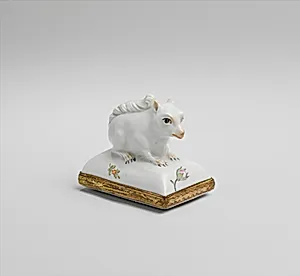
Snuffbox in the form of a squirrel
Medium
Hard-paste porcelain, copper gilt
Dimensions
Length: 2 3/4 in. (7 cm)
Classification
Ceramics-Porcelain
Culture
German, Schrezheim
Department
European Sculpture and Decorative Arts
Museum
Metropolitan Museum of Art, New York, NY
Credit
The Jack and Belle Linsky Collection, 1982
Accession Number
1982.60.348
Rights
Public Domain
Tags
Art Historical Context
This delightful snuffbox, crafted around 1761–70 by Johann Andreas Bechdolff at the Schrezheim Manufactory in Germany, takes the whimsical form of a squirrel. Measuring just 2¾ inches long, it's made of hard-paste porcelain—a prized European innovation that mimicked the durability and translucency of Chinese porcelain, achieved through high-fired kaolin clay. The addition of copper gilt accents lends a luxurious shimmer, highlighting the squirrel's fur, eyes, and tail in opulent Rococo style, popular in mid-18th-century decorative arts for its playful naturalism. Schrezheim, a modest Württemberg porcelain factory, specialized in finely modeled figures and novelties like this one, competing with giants like Meissen. Snuffboxes were essential accessories for the elite, who carried finely ground tobacco as a fashionable stimulant. Shaping one as a lively squirrel reflects the era's delight in animal motifs, symbolizing curiosity and abundance in European decorative culture. Today, this gem from The Jack and Belle Linsky Collection at The Metropolitan Museum of Art showcases the technical mastery and charm of German porcelain, inviting us to appreciate how everyday luxuries blended utility with artistry. (198 words)
About the Artist
Johann Andreas Bechdolff|Schrezheim Manufactory (German| ) · | – |
German|