
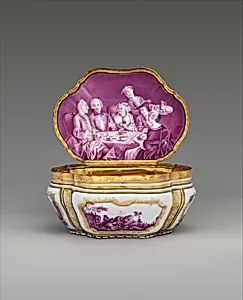
Table snuffbox
ca. 1750
Medium
Hard-paste porcelain, copper gilt
Dimensions
H. 4 in. (10.2 cm.); W. 6 3/4 in. (17.1 cm.); D. 4 7/8 in. (12.4 cm.)
Classification
Ceramics-Porcelain
Culture
German, Meissen
Department
European Sculpture and Decorative Arts
Museum
Metropolitan Museum of Art, New York, NY
Credit
Bequest of Irwin Untermyer, 1973
Accession Number
1974.28.124
Rights
Public Domain
Tags
Art Historical Context
Step into the opulent world of 18th European aristocracy with this exquisite *Table Snuffbox* from the Meissen Manufactory, 1750. Crafted in Germany, the epicenter of porcelain innovation, Meissen was the first European factory to produce true hard-paste porcelain—a durable, translucent material rivaling prized Chinese imports. This compact luxury object (H. 4 in.; W. 6 3/4 in.; D. 4 7/8 in.) served as a tabletop container for finely ground snuff tobacco, a fashionable indulgence among the elite. Adorned with intricate hand-painted scenes of men and women reveling at a lively party—complete with smoking motifs—the snuffbox showcases Meissen's mastery of Rococo exuberance. Delicate modeling, vibrant enamels, and copper gilding highlight its decorative flair, blending sculptural finesse with painterly detail. The hard-paste body allowed for sharp edges and complex forms unattainable in softer wares, elevating it from mere utility to status symbol. A bequest to the Metropolitan Museum of Art in 1973, this piece captures the era's social rituals: snuff-taking as a refined pastime, fostering flirtation and conversation in gilded salons. It whispers of Enlightenment leisure, where porcelain artistry mirrored the playful, ornate spirit of the time.
About the Artist
Meissen Manufactory · 1710–present
The Meissen Manufactory, established on June 6, 1710, by Augustus the Strong, Elector of Saxony and King of Poland, marked the dawn of true hard-paste porcelain production in Europe. Nestled at Albrechtsburg Castle in Meissen near Dresden, the Royal Polish and Electoral Saxon Porcelain Manufactory arose from alchemical experiments begun in 1708 by physicist Ehrenfried Walther von Tschirnhaus and p...