
Social Triumph (Le Triomphe mondain)
c. 1886
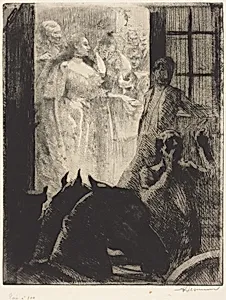
Medium
etching, aquatint, and printed tone on laid japan paper
Dimensions
plate: 31.9 x 24.8 cm (12 9/16 x 9 3/4 in.) sheet: 43.2 x 34 cm (17 x 13 3/8 in.)
Classification
Department
CG-E
Museum
National Gallery of Art, Washington, D.C.
Credit
Gift of Mr. and Mrs. Daniel Bell
Accession Number
1996.136.2
Rights
Public Domain
Art Historical Context
Albert Besnard created *Social Triumph (Le Triomphe mondain)* around 1886, a print that reflects the refined techniques of late-nineteenth-century French art. Working in etching combined with aquatint and printed tone, Besnard produced this intimate plate on laid japan paper, a delicate yet resilient support prized for its ability to hold fine lines and subtle tonal shifts. The resulting impression, with its modest plate size of roughly 32 by 25 centimeters, invites close looking. Etching allowed the artist to draw directly into a prepared metal plate, while aquatint introduced velvety areas of tone that suggest atmosphere and volume. The added printed tone further unifies the surface, creating a cohesive, almost painterly effect unusual in purely linear prints. Japan paper’s distinctive laid texture enhances these qualities, giving the work a tactile richness that complements its subject. The French title, meaning “The Worldly Triumph,” evokes the glittering social world of the period, perhaps capturing a moment of fashionable success or elegant gathering. Gifted to the National Gallery of Art by Mr. and Mrs. Daniel Bell, the print stands as both a technical achievement and a window onto the cultural fascination with society and display in Besnard’s time.
About the Artist
Albert Besnard · 1849–1934
Paul-Albert Besnard, known as Albert Besnard, was born on June 2, 1849, in Paris to an artistic family: his father, Louis Adolphe Ferdinand Besnard, was a history painter and pupil of Ingres, while his mother, Marie Louise Pauline Vaillant, was a noted miniaturist trained under Lizinska de Mirbel. Precociously talented, he began his training under Jean-François Brémond before entering the École de...