
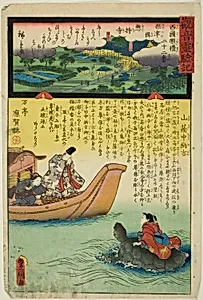
Soji Temple in Settsu Province, No. 22 on the Saikoku Pilgrimage Route (Saikoku junrei nijuniban Settsu no kuni Sojiji), from the series "The Miracles of Kannon (Kannon reigenki)"
Medium
Color woodblock print; oban
Classification
woodblock print
Department
Arts of Asia
Museum
Art Institute of Chicago
Accession Number
92251
Rights
Public Domain
Art Historical Context
In the bustling world of 19th-century Japan, Utagawa Kunis I (also known as Toyokuni), a master of the ukiyo-e tradition, created this striking color woodblock print in 1859. Titled *Soji Temple in Setu Province, No. 22 on the Saik Pilgrimage Route*, it part of the series * Miracles of Kannon (Kannon reigenki)* This oban-sized print (a standard large format, about 14 x 10 inches) captures the serene Sojiji Temple in what is now Osaka Prefecture, one of the 33 sacred Kannon temples on the famed Saikoku Pilgrimage—a devotional journey for the compassionate Bodhisattva Kannon, revered for granting miracles to the faithful. Kunisada's work reflects the late Edo period's fascination with religious tourism, blending spiritual narratives with vivid landscapes and figures. Pilgrimage guides like this popularized temple visits among commoners, fostering cultural devotion amid Japan's feudal society. His ukiyo-e style shines through intricate details: bold colors layered via multiple woodblocks, delicate gradations (bokashi), and dynamic compositions that evoke the temple's mystical aura, perhaps hinting at a Kannon miracle through ethereal mists or pious pilgrims. Housed in the Art Institute of Chicago's Arts of Asia department, this print exemplifies woodblock printing's democratic power—affordable art that brought sacred stories to everyday viewers, preserving Japan's rich Buddhist heritage as modernization loomed.
About the Artist
Utagawa Kunisada I (Toyokuni III) · 1786–1864
Utagawa Kunisada I, also known as Toyokuni III (1786–1865), was born Sumida Shōgorō in the Honjo district of Edo (modern Tokyo) into a family that operated a hereditary ferry-boat service, providing stability after his father's early death. Displaying prodigious talent in drawing from childhood, he became an apprentice to the master Utagawa Toyokuni I around 1801 at age fifteen, entering the prest...