
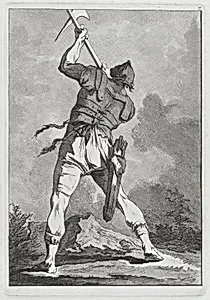
Soldier Wielding a Weapon, Seen from Behind
Medium
Etching
Dimensions
Sheet: 18 1/16 × 11 11/16 in. (45.8 × 29.7 cm)
Classification
Prints
Department
Drawings and Prints
Museum
Metropolitan Museum of Art, New York, NY
Credit
The Elisha Whittelsey Collection, The Elisha Whittelsey Fund, 2018
Accession Number
2018.54.7
Rights
Public Domain
Tags
Art Historical Context
In the Metropolitan Museum of Art's Drawings and Prints department, *Soldier Wielding a Weapon Seen from Behind* (1764), a striking etching by Philippe Jacques detherbourg and Matthias Pninger. Measuring an impressive 18 116 × 11 11/16 inches on its sheet, this print captures lone soldier in a dynamic rear view, gripping his weapon with poised intensity. The collaboration between Loutherbourg, a versatile artist known for his dramatic compositions, and Pfenninger the era's fascination with military prowess amid Europe's post-Seven Years' War reflections. Etching, as the chosen medium, allowed for intricate, fluid lines etched into a metal plate with acid, enabling rich tonal contrasts and expressive detail—perfect for conveying the soldier's musculature and motion. This technique was prized in 18th-century printmaking for its accessibility, reproducing painterly effects for wider audiences beyond oil canvases. Acquired through The Elisha Whittelsey Collection via the Elisha Whittelsey Fund in 2018, this work invites us to ponder the human scale of warfare through its intimate focus on one figure. A testament to Enlightenment-era artistry, it blends technical innovation with timeless themes of strength and solitude.
About the Artist
Philippe Jacques de Loutherbourg|Matthias Pfenninger · 1740–1812
Philippe Jacques de Loutherbourg, born in Strasbourg in 1740 to a Swiss miniaturist and engraver, initially pursued studies at the University of Strasbourg for the Lutheran ministry before turning decisively to art. In 1755, he moved to Paris, where he studied under the history painter Charles-André van Loo and the battle specialist Francesco Giuseppe Casanova, later training with engraver Jean-Ge...