
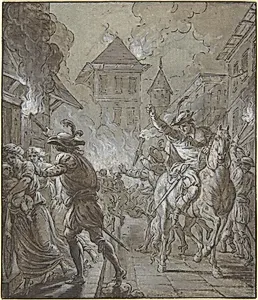
Soldiers pillaging a town
17th century
Medium
Pen and black and brown ink, brush and brown wash, heightened with white, on laid paper prepared with gray wash; framing lines in pen and black ink
Dimensions
sheet: 4 5/16 x 3 3/4 in. (11 x 9.5 cm)
Classification
Drawings
Department
Drawings and Prints
Museum
Metropolitan Museum of Art, New York, NY
Credit
The Elisha Whittelsey Fund, 1952
Accession Number
52.567.2
Rights
Public Domain
Tags
Art Historical Context
This anonymous 17th-century drawing captures the brutal realities of warfare through a compact scene of soldiers looting a burning town. Amid the chaos, figures on horseback ransack homes while women and infants flee, highlighting the devastating impact of conflict on civilians. Created during an era marked by prolonged European wars such as the Thirty Years’ War, the work reflects the period’s widespread violence and social upheaval, themes frequently explored in art to document or critique contemporary events. The employed pen and ink with brown wash on gray-prepared paper, heightened with white for dramatic contrasts of light and shadow. This technique allows for expressive, rapid strokes that convey movement and emotion, while the small scale—roughly four by four inches—suggests it may have served as a study or modello for a larger painting or print. The careful framing lines further indicate its status as a finished drawing intended for viewing or collection. Such works offer valuable insight into 17th-century artistic responses to war, blending documentary detail with emotional intensity to engage viewers in the human cost of conflict.
About the Artist
Anonymous, 17th century · 1600–1700
**Anonymous, 17th century** remains one of the most intriguing figures—or rather, non-figures—in art history, representing the countless unnamed painters, draftsmen, and sculptors whose works survive from the Baroque era. Active across Europe between 1600 and 1700, this designation encompasses artists whose identities have been lost to time, yet whose output forms a substantial part of museum coll...