
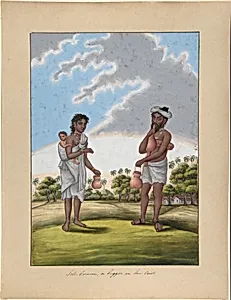
Solf-Coraven, or Beggar, from Indian Trades and Castes
ca. 1840
Medium
Watercolor and gouache
Dimensions
sheet: 14 3/8 x 10 3/8 in. (36.5 x 26.4 cm) mount: 18 1/4 x 14 1/4 in. (46.4 x 36.2 cm)
Classification
Drawings
Department
Drawings and Prints
Museum
Metropolitan Museum of Art, New York, NY
Credit
Rogers Fund, 1970
Accession Number
1970.548.6
Rights
Public Domain
Tags
Art Historical Context
This evocative watercolor and gouache, created around 1840 by an anonymous Indian artist, belongs to the series *Indian Trades and Castes*. Such works were often produced for British patrons during the colonial era, offering detailed glimpses into the social fabric of 19th-century India. The title identifies the central figure as “Solf-Coraven, or Beggar,” and the composition includes men, women, and infants, suggesting a family scene that highlights everyday life within the caste system. The medium—vibrant pigments applied with fine brushwork—reflects a blend of traditional Indian miniature techniques and the documentary style favored by European collectors. These images served both as ethnographic records and as colorful souvenirs, capturing occupations and social roles with careful attention to costume, gesture, and setting. Acquired by the Metropolitan Museum of Art through the Rogers Fund in 1970, the sheet offers modern viewers a window into how Indian artists responded to outside interest while preserving rich visual details of their own society.
About the Artist
Anonymous, Indian, 19th century · 1800–1900
**Anonymous, Indian, 19th Century (ca. 1800–1900)** The artist cataloged as Anonymous, Indian, 19th century represents one of countless skilled Indian painters whose identities remain elusive in historical records, active during a transformative era under British colonial influence. Working roughly between 1800 and 1900, this anonymous figure exemplifies the legion of indigenous artists who adapt...