
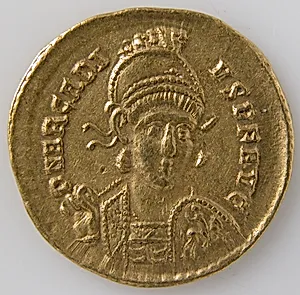
Solidus
Unknown Artist
396–408
Medium
Gold
Dimensions
Overall: 13/16 x 1/16 in. (2 x 0.1 cm)
Classification
Coins
Culture
Byzantine
Department
Medieval Art
Museum
Metropolitan Museum of Art, New York, NY
Credit
Gift of Darius Ogden Mills, 1904
Accession Number
04.2.818
Rights
Public Domain
Art Historical Context
Step into the glittering world of the Byzantine Empire with this exquisite *Solidus*, a gold coin minted between 396 and 408 CE. Measuring just 13/16 x 1/16 inches, this tiny treasure from the Medieval Art collection at the Metropolitan Museum of Art the empire's mastery of numismatic art. Gifted by Darius Ogden Mills in 1904, it reflects the economic and political stability of Byzantium, where gold solidi served as the backbone of international trade and imperial prestige. Crafted from pure gold, the solidus was a revolutionary currency introduced earlier by Emperor Constantine the Great, maintaining a consistent weight and purity that symbolized the empire's enduring power. These coins were struck with remarkable precision, featuring finely detailed portraits of emperors—likely Arcadius or Honorius during this period—on the obverse, and symbolic motifs like Victory or a cross on the reverse. Such imagery propagated imperial authority and Christian faith across a vast realm stretching from Europe to Asia. Beyond its economic role, this solidus offers a window into Byzantine cultural sophistication, blending Roman traditions with emerging Christian iconography. As a portable emblem of sovereignty, it traveled trade routes, influencing economies from Constantinople to distant courts, reminding us how even the smallest artifacts can encapsulate an empire's grandeur.