
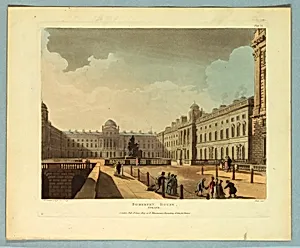
Somerset House, Strand, from "Ackermann's Repository"
Medium
Classification
Department
Smithsonian Collection
Museum
Smithsonian American Art Museum
Credit
Gift of Hamill and Barker
Accession Number
1961-105-282
Rights
Public Domain
About this artwork
Research in Progress
Art Historical Context
Thomas Rowlandson’s 1809 print captures Somerset House along London’s Strand, offering a glimpse of one of the city’s most important neoclassical landmarks. A prolific British artist celebrated for his witty caricatures and lively urban scenes, Rowlandson contributed regularly to Rudolph Ackermann’s Repository of Arts, a fashionable monthly publication that brought hand-colored prints of architecture, fashion, and daily life into middle-class homes. This particular view reflects the early nineteenth-century taste for topographical imagery that celebrated London’s transformation into a modern metropolis. Printed as an aquatint or etching, the work exemplifies how reproductive media allowed artists to reach wide audiences beyond the elite collectors who purchased original drawings. Rowlandson’s fluid line and gentle humor soften the grandeur of Sir William Chambers’s imposing riverside palace, turning a symbol of government and the arts into an approachable scene of everyday London. Now part of the Smithsonian American Art Museum’s collection through the generosity of Hamill and Barker, the print preserves a moment when printed images helped shape public perceptions of both the city and its cultural institutions.