
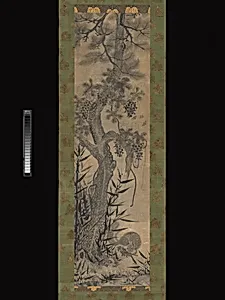
松竹葡萄栗鼠図|소나무, 대나무, 포도, 그리고 다람쥐|Sonamu, daenamu, podo, geuligo dalamjwi|Pine, Bamboo, Grape, and Squirrel
18th–19th century
Medium
Hanging scroll; ink on paper
Dimensions
Image: 41 × 11 5/16 in. (104.1 × 28.7 cm) Overall with mounting: 73 7/8 × 16 3/16 in. (187.6 × 41.1 cm)
Classification
Paintings
Culture & Period
Korea and Japan · Joseon dynasty (1392–1910)
Department
Asian Art
Museum
Metropolitan Museum of Art, New York, NY
Credit
Mary and Cheney Cowles Collection, Gift of Mary and Cheney Cowles, 2022
Accession Number
2022.432.10
Rights
Public Domain
Art Historical Context
This delicate hanging scroll, titled *Pine, Bamboo, Grape, and Squirrel* (松竹葡萄栗鼠図), hails from the 18th–19th century during Korea's Joseon dynasty (2–1910), a period renowned for its refined scholarly arts. Crafted in ink on paper the work measures 41 × 5/16 inches and features a pine tree, bamboo stalks, ripe grape clusters, and able squirrel amid branches. Though the artist is unidentified, the composition reflects East Asian conventions blending Korean and Japanese aesthetics, where nature's motifs convey deeper harmony. These elements carry rich symbolism: pine evokes longevity and steadfastness, bamboo resilience and integrity, grapes abundance and fertility, and the squirrel playful diligence—auspicious themes ideal for scholarly contemplation. Hanging scrolls like this were not everyday displays but special unfoldings for seasonal gatherings or meditation, underscoring their cultural prestige in Joseon elite circles. The ink medium highlights masterful brushwork, from bold contours on bark to subtle washes for leaves and fur, creating depth through line and empty space. Acquired through the Mary and Cheney Cowles Collection at the Metropolitan Museum of Art, this piece invites visitors to savor the quiet poetry of Joseon-era nature painting.
About the Artist
Unidentified ( ) · –