
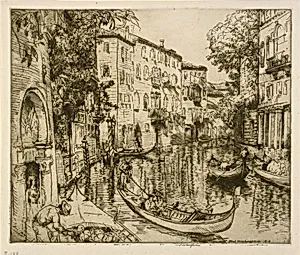
Song from Venice no. 2
Medium
Graphic Arts-Print
Classification
Graphic Arts-Print
Department
Smithsonian Collection
Museum
Smithsonian American Art Museum
Credit
Smithsonian American Art Museum, Gift of Moune G.H. Webster
Accession Number
1974.85.64
Rights
Public Domain
Tags
Art Historical Context
Donald Shaw MacLaughlan's *Song from Venice no. 2* (1912) captures the timeless romance of Venice through a delicate etching, a graphic arts print that showcases the artist's mastery of line and tone. The scene evokes a moonlit canal where a gondola glides, carrying a courting couple—a man and woman serenading each other amid the city's labyrinthine waterways. MacLaughlan, a Canadian-American etcher renowned for his European travels, drew inspiration from Venice's enchanting atmosphere, blending intimate human moments with the city's iconic architecture. Created during the etching revival of the early 20th century, this work highlights the print medium's power to democratize art, allowing intricate details like rippling water and gondola curves to be reproduced with exquisite precision. MacLaughlan's fine, atmospheric lines reflect his affiliation with the tonalist movement, emphasizing mood over stark realism and evoking nostalgia for la dolce vita. Housed in the Smithsonian American Art Museum through a generous gift, this print invites visitors to ponder Venice's cultural allure as a haven for lovers and dreamers, a motif that resonated in the pre-World War I era before global upheavals. A poetic snapshot of fleeting serenade on the lagoon.
About the Artist
Donald Shaw MacLaughlan · 1876–1938
Donald Shaw MacLaughlan (1876–1938) was born on November 9 in Charlottetown, Prince Edward Island, Canada, though he is recognized as an American artist after his family relocated to Boston, Massachusetts, in 1890. There, as a teenager, he immersed himself in the Boston Public Library's collections of old master prints, studying works by Albrecht Dürer, Rembrandt van Rijn, and eighteenth-century E...