
Song Sparrow
Medium
animals
Classification
animals
Department
Smithsonian Collection
Museum
Smithsonian American Art Museum
Credit
Smithsonian American Art Museum
Accession Number
1953-48-30
Rights
Public Domain
About this artwork
Research in Progress
Art Historical Context
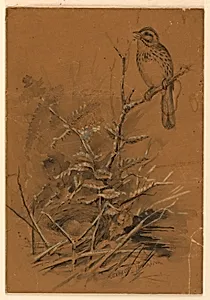
**Song Sparrow** (1893) by Ernest Thompson Seton captures the delicate beauty of North American wildlife in a work from the Smithsonian American Art Museum's collection. Created during Seton's early career, this piece reflects his lifelong passion for observing and illustrating animals with scientific precision and artistic grace. Born in England but embracing an American identity, Seton (1860–1946) was a pioneering naturalist-artist whose drawings and paintings bridged art, science, and conservation at the turn of the 20th century. Seton's realistic style, rooted in the naturalist tradition, emphasized anatomical accuracy and behavioral authenticity—qualities honed through his fieldwork in the American West. The song sparrow, a common yet enchanting bird known for its melodic calls, symbolizes the everyday wonders of nature that Seton championed. His works often appeared in books like *Wild Animals I Have Known* (1898), influencing public appreciation for wildlife and foreshadowing the environmental movement. Housed in the Smithsonian Collection and classified among animal-themed artworks, *Song Sparrow* invites visitors to ponder Seton's legacy as both storyteller and visual chronicler. Though research continues, it stands as a testament to 19th-century efforts to celebrate nature's intricacies amid rapid industrialization. (198 words)