
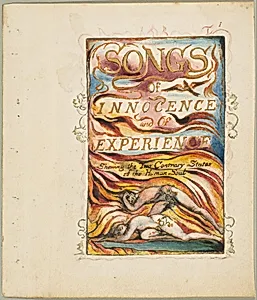
Songs of Innocence and of Experience: Shewing the Two Contrary States of the Human Soul
[1789–94] printed ca. 1825
Medium
Relief etching printed in orange-brown ink and hand-colored with watercolor, ink and shell gold
Dimensions
Each plate approx: 4 7/16 × 2 13/16 in. (11.2 × 7.1 cm) Each sheet approx: 6 3/16 x 5 9/16 in. (15.7 x 14.1 cm)
Classification
Prints
Department
Drawings and Prints
Museum
Metropolitan Museum of Art, New York, NY
Credit
Rogers Fund, 1917
Accession Number
17.10.1–54
Rights
Public Domain
Art Historical Context
William Blake's *Songs of Innocence and Experience: Shewing the Contrary States of the Human* (1789–94, printed ca. 182) is a visionary masterpiece of Romantic literature and art. This illuminated book juxtaposes 54 poems and illustrations exploring the dualities of human existence—innocence versus experience, joy versus suffering—reflecting Blake's radical critique of Enlightenment rationalism and industrial society's spiritual toll. Composed during the turbulent era of the French Revolution, it embodies his belief in imagination as a divine force. Blake invented a revolutionary "relief etching" technique, carving text and images into copper plates, printing them in orange-brown ink, and hand-coloring each copy with watercolor, ink, and shell gold. This labor-intensive process ensured every edition was unique, blending poetry, prophecy, and visual poetry in compact plates (approx. 4⅞ × 2¾ in.). Housed in the Metropolitan Museum of Art's Drawings and Prints department (Rogers Fund, 1917), it highlights his mystical style, influencing generations of artists and poets. A cultural touchstone, the work invites visitors to ponder timeless questions: Can innocence endure amid experience's harsh lessons? Blake's ethereal figures and vibrant hues make it a profound, pocket-sized portal to the soul's contrary states.
About the Artist
William Blake · 1757–1827
William Blake (1757–1827) stands as one of the most visionary and unconventional artists in British history, a poet-painter-printmaker whose mystical imagination and radical vision profoundly shaped the Romantic movement. Born in London's Soho district, Blake experienced visions from childhood—claiming to see angels in trees at age eight—and these spiritual encounters would guide his art throughou...