
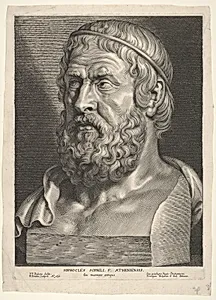
Sophocles (after Rubens)
Medium
Engraving
Dimensions
plate: 12 1/16 x 8 11/16 in. (30.6 x 22 cm) sheet: 13 3/16 x 9 5/8 in. (33.5 x 24.4 cm)
Classification
Prints
Department
Drawings and Prints
Museum
Metropolitan Museum of Art, New York, NY
Credit
Bequest of Phyllis Massar, 2011
Accession Number
2012.136.459
Rights
Public Domain
Tags
Art Historical Context
Behold this striking engraving, *Sophocles (after Rubens)*, created in 1638 by the Flemish engraver Paulus Pontius based on a design by the master painter Peter Paul Rubens. It captures the ancient Greek tragedian Sophocles, whose plays like *Oedipus Rex* defined classical drama, reimagined through the lens of 17th-century Baroque grandeur. Pontius's meticulous lines evoke Rubens's signature style—dynamic poses, expressive features, and a sense of profound intellect—transforming a lost or hypothetical painting into an enduring print portrait. As a product of the Rubens workshop, this work exemplifies the collaborative artistry of Antwerp's Golden Age. Rubens, a leading Baroque figure, often depicted classical heroes to bridge antiquity and his era's humanism, while Pontius specialized in reproductive engravings that popularized these images among Europe's elite collectors and scholars. The intaglio technique of engraving allowed for rich tonal depth and fine detail, evident in the plate's precise 12 1/16 x 8 11/16 inches, making complex shading and textures possible on a portable scale. Housed in the Metropolitan Museum of Art's Drawings and Prints department (Bequest of Phyllis Massar, 2011), this print highlights prints' democratic role in art history: spreading Rubens's vision far beyond oil canvases. For visitors, it's a portal to how Renaissance reverence for the ancients fueled Baroque innovation, inviting reflection on timeless genius.