
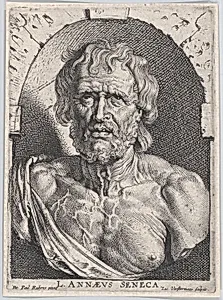
The bust of Seneca, in a niche
Medium
Etching and engraving; second state of two
Dimensions
Plate: 5 3/8 × 3 15/16 in. (13.7 × 10 cm) Sheet (Trimmed): 5 9/16 × 4 1/16 in. (14.1 × 10.3 cm)
Classification
Prints
Department
Drawings and Prints
Museum
Metropolitan Museum of Art, New York, NY
Credit
Bequest of Grace M. Pugh, 1985
Accession Number
1986.1180.1367
Rights
Public Domain
Tags
Art Historical Context
This striking print from around 1620 presents a classical bust of the Roman philosopher Lucius Annaeus Seneca (c. 4 BCE–65 CE) nestled within an architectural niche. Created through the combined efforts of Peter Paul Rubens, who likely supplied the design, and engraver Lucas Vorsterman I, the image captures Seneca’s dignified, bearded features with remarkable clarity and depth. The work belongs to a tradition of reproductive prints that brought celebrated antiquities and artistic inventions to a wider audience in the seventeenth century. Rubens, a leading figure of the Flemish Baroque, maintained a deep fascination with ancient Roman culture, often incorporating classical motifs into his paintings and designs. By collaborating with skilled printmakers like Vorsterman, he helped disseminate images of antiquity across Europe. The medium of etching and engraving allowed for fine detail and tonal richness, making it ideal for rendering the sculptural qualities of the bust while preserving its monumental presence on a modest scale. Today housed in the Metropolitan Museum of Art, this second-state impression exemplifies how prints served both as artistic records and as vehicles for intellectual and cultural exchange during the Baroque era.
About the Artist
Peter Paul Rubens|Lucius Annaeus Seneca|Lucas Vorsterman I · 1577–1640
Peter Paul Rubens (1577-1640) stands as the most influential artist of the Flemish Baroque tradition and the greatest exponent of Baroque painting's dynamism, vitality, and sensuous exuberance. Born in Siegen, Westphalia, and raised in Antwerp, Rubens received a humanist education studying Latin and classical literature before pursuing artistic training under three masters: Tobias Verhaecht, Adam ...