
Sorrow (Chagrin)
1919
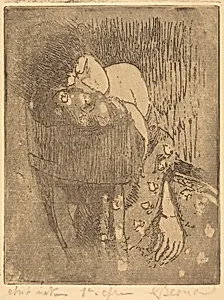
Medium
etching and aquatint on Van Gelder laid paper
Dimensions
plate: 13.9 x 10.7 cm (5 1/2 x 4 3/16 in.) sheet: 17.2 x 13.2 cm (6 3/4 x 5 3/16 in.)
Classification
Department
CG-E
Museum
National Gallery of Art, Washington, D.C.
Credit
Gift of Mr. and Mrs. Daniel Bell
Accession Number
1993.71.19
Rights
Public Domain
Art Historical Context
**Sorrow (Ch)**, a poignant 1919 etching andatint by French artist Besnard, captures the depth of human experience through masterful printmaking.nard (1849–4), renowned for his Symbolist-influenced and later decorative murals, this intimate work on Vander laid paper—a premium Dutch handmade sheet prized its texture and durability in fine prints Measuring just 13.9 x10.7 cm on plate, its small scale invites close contemplation, ev personal grief amid the post-World I era's widespread melancholy. The technique shines here: etching delivers precise, incisive lines contours and expression, while aquint introduces velvety tonal gradients, mimicking painting's sfumato for subtle shading and mood. This combination allowed Besnard to infuse prints with a painterly richness rare in the medium, bridging his oil paintings' theatricality with graphic intimacy. Housed in the National Gallery of Art as a gift from Mr. and Mrs. Daniel Bell (Department CG-E), it exemplifies early 20th-century French printmaking's technical innovation. In a time of global sorrow, *Sorrow* resonates as a timeless meditation on chagrin, showcasing Besnard's skill in distilling profound emotion into delicate lines and shadows. Visitors will appreciate its quiet power up close.
About the Artist
Albert Besnard · 1849–1934
Paul-Albert Besnard, known as Albert Besnard, was born on June 2, 1849, in Paris to an artistic family: his father, Louis Adolphe Ferdinand Besnard, was a history painter and pupil of Ingres, while his mother, Marie Louise Pauline Vaillant, was a noted miniaturist trained under Lizinska de Mirbel. Precociously talented, he began his training under Jean-François Brémond before entering the École de...