
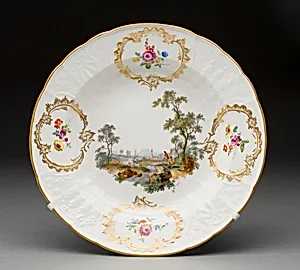
Soup Plate
Medium
Hard-paste porcelain, polychrome enamels, and gilding
Dimensions
4.5 × 23.9 cm (1 3/4 × 9 3/8 in.); Diam.: 23.9 cm (9 3/8 in.)
Classification
plate (general, dish)
Department
Applied Arts of Europe
Museum
Art Institute of Chicago
Accession Number
147437
Rights
Public Domain
Art Historical Context
This elegant soup plate, crafted by the renowned Meissen Porcelain Manufactory between 1763 and 1774, exemplifies the pinnacle of 18th-century European porcelain artistry. Founded in 1710 near Dresden, Germany, Meissen was Europe's first producer of true hard-paste porcelain—a durable, translucent material rivaling prized Chinese imports, often dubbed "white gold." By the mid-1700s, the manufactory supplied luxury tableware to royalty and aristocracy, blending technical innovation with opulent decoration. Measuring 23.9 cm in diameter, this plate features hard-paste porcelain enhanced by vibrant polychrome enamels—fired-overglaze colors that allowed for intricate, fade-resistant patterns—and lavish gilding for a shimmering gold rim. These techniques highlighted Meissen's mastery, enabling lifelike floral motifs, scenic vignettes, or exotic chinoiserie designs that reflected Rococo tastes for whimsy and refinement. Such pieces were integral to grand dinner services, symbolizing wealth and cultural sophistication during the Enlightenment era. Housed in the Art Institute of Chicago's Department of Applied Arts of Europe, this soup plate invites visitors to appreciate how everyday objects became canvases for artistic excellence, bridging functionality and fine art in the opulent courts of Europe.
About the Artist
Meissen Porcelain Manufactory
The Meissen Porcelain Manufactory, established on June 6, 1710, by Augustus II the Strong, Elector of Saxony and King of Poland, in the Albrechtsburg castle at Meissen near Dresden, marked Europe's breakthrough in producing true hard-paste porcelain. Building on experiments by physicist Ehrenfried Walther von Tschirnhaus and alchemist Johann Friedrich Böttger, who perfected the formula using local...