
Soup tureen
1758–59
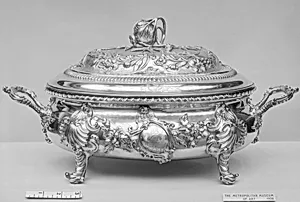
Medium
Silver
Dimensions
Overall: 9 3/4 × 10 × 18 3/8 in. (24.8 × 25.4 × 46.7 cm)
Classification
Metalwork-Silver
Culture
British, London
Department
European Sculpture and Decorative Arts
Museum
Metropolitan Museum of Art, New York, NY
Credit
Gift of Banyer Clarkson, 1928
Accession Number
28.92a, b
Rights
Public Domain
Tags
Art Historical Context
This elegant soup tureen, crafted by London silversmith John Swift 1758–59, exemplifies the opulence of mid-18th-century Britishware. Measuring nearly 18 inches long, it was designed as a grand serving vessel for the dining tables of the elite, reflecting the Georgian era's fascination with lavish entertaining. Swift, a noted member of London's prestigious silversmith community, marked his work with hallmarks that guaranteed its quality and, making pieces like this heirlooms. Fashion from gleaming silver, the tureen showcases intricate floral motifs—evident in its decorative tags—that evoke the Rococo style's playful abundance of nature-inspired ornamentation. Such metalwork required masterful techniques like chasing and embossing to create depth and texture, transforming functional dishware into sculptural art. In European homes, these tureens symbolized wealth and hospitality, often used in formal banquets to serve soup in style. Today, this tureen resides in the Metropolitan Museum of Art's Department of European Sculpture and Decorative Arts, a gift from Banyer Clarkson in 1928. It invites us to appreciate how everyday rituals were elevated to high art in 18th-century Britain.