
Southern Barbarians
mid 17th century
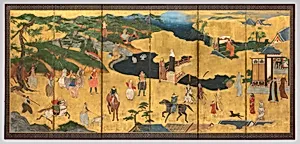
Medium
Pair of six-panel screens; ink, colors, and gold on paper
Dimensions
Each: 170.4 × 370 cm (67 1/8 × 145 11/16 in.)
Classification
screen
Department
Arts of Asia
Museum
Art Institute of Chicago
Accession Number
23480
Rights
Public Domain
Art Historical Context
Welcome to the Art Institute of Chicago's Arts of Asia collection, where you'll encounter the captivating *Southern Barbarians*, a pair of magnificent six-panel folding screens from mid-17th-century Japan. Created by an unknown artist using ink, vibrant colors, and lavish gold leaf on paper—each screen measuring an impressive 170.4 × 370 cm—these byōbu (folding screens) were prized luxury items in Japanese homes and castles, serving both as room dividers and storytelling backdrops. The screens vividly depict Portuguese traders and missionaries, known as *nanban* or "southern barbarians," arriving by ship in Japanese ports during the late Momoyama to early Edo period. This era marked a brief window of intense cultural exchange before Japan's 1639 sakoku policy sealed the nation from most foreign contact. Gold-flecked backgrounds evoke shimmering seas and skies, while intricate ink details capture exotic ships, firearms, clocks, and woolen clothing—symbols of global trade that fascinated Japanese viewers. Artistically, these screens exemplify *nanban art*, blending traditional Japanese techniques like delicate brushwork and asymmetrical composition with novel European motifs. They offer a rare glimpse into Japan's curiosity about the wider world, highlighting themes of wonder, commerce, and cultural collision that shaped early modern history.
About the Artist
Unknown
The artist designated as "Unknown" in our virtual museum's collection exemplifies a poignant chapter in art history: creators whose identities have faded into obscurity despite the enduring power of their work. With only one known artwork attributed to them in our holdings, this figure represents countless anonymous hands that shaped visual culture across centuries. Museums worldwide, including th...