
Souvenir of Italy
1866
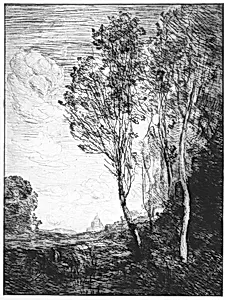
Medium
Etching; first state of four
Dimensions
Sheet: 20 1/4 × 13 13/16 in. (51.4 × 35.1 cm) Plate: 12 1/2 × 9 3/8 in. (31.8 × 23.8 cm)
Classification
Prints
Department
Drawings and Prints
Museum
Metropolitan Museum of Art, New York, NY
Credit
Harris Brisbane Dick Fund, 1924
Accession Number
24.37.2
Rights
Public Domain
Tags
Art Historical Context
Camille Corot's *Souvenir of Italy*1866) captures the artist's enduring love for the Italian landscape in a delicate etching, the first state of four. a leading figure in the Barbizon school and a bridge to Impressionism, Corot was renowned for his poetic depictions of nature, often with soft, atmospheric light. This print, measuring 12½ × 9⅜ inches on the plate, evokes memories of his formative travels to Italy in the 1820s and 1830s, where he sketched ancient ruins and lush vistas that shaped his lifelong oeuvre. Etching allowed Corot to explore intricate line work and tonal subtleties beyond his oil paintings, using acid to bite into a metal plate for a rich, velvety texture. The "first state" signifies its pristine form before later reworkings, making it a rare glimpse into the artist's evolving process. Trees, a recurring motif tagged here, anchor the composition, symbolizing nature's timeless serenity amid Italy's historic charm. Acquired through the Harris Brisbane Dick Fund in 1924, this work from the Met's Drawings and Prints department highlights 19th-century printmaking's role in democratizing art. Visitors will appreciate how Corot's intimate etching distills grand souvenirs into portable poetry.
About the Artist
Camille Corot · 1796–1875
Jean-Baptiste-Camille Corot, born in Paris on July 16, 1796, into a prosperous bourgeois family—his father a former wig maker turned draper, his mother a successful milliner—initially resisted his artistic calling. After a lackluster education at the Lycée Pierre-Corneille in Rouen and failed apprenticeships in business, he abandoned commerce at age 26, thanks to a generous parental allowance foll...