
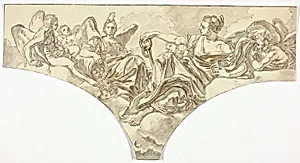
Spandrel Decoration with Seated Allegorical Figures of Hope and Concord
Medium
Pen and brown ink with brush and brown and gray wash, over traces of black chalk, squared in black chalk on ivory laid paper
Dimensions
18.7 × 35.5 cm (7 3/8 × 14 in.)
Classification
ink or chalk wash
Department
Prints and Drawings
Museum
Art Institute of Chicago
Accession Number
85475
Rights
Public Domain
Art Historical Context
In the intricate *Spandrel Decoration with Seated Allegorical Figures Hope and Concord*, Francesco Solimena captures the grandeur of Baroque allegory through poised female figures embodying virtues central to 17th- and 18th-century European iconography. Hope, often depicted with an anchor or olive branch, and Concord, symbolizing harmony with clasped hands or a cornucopia, sit gracefully within the curved, triangular space typical of spandrels—the ornamental panels above arches in architecture. This preparatory drawing, housed in the Art Institute of Chicago's Prints and Drawings Department, measures a modest 18.7 × 35.5 cm, yet brims with dynamic energy suited for grand frescoes or ceiling designs. Solimena, a leading Neapolitan Baroque artist active from the late 1600s to mid-1700s, mastered dramatic compositions blending Roman classicism with southern Italian exuberance. His theatrical style, evident here in the flowing drapery and expressive poses, reflects the Counter-Reformation's emphasis on emotional religious art. The "squared" grid in black chalk reveals its practical purpose: a cartoon for scaling up to larger murals, a common technique in workshops of the era. Crafted with pen and brown ink, brush with brown and gray washes over black chalk traces on ivory laid paper, the work showcases Solimena's virtuoso handling of light and shadow. Washes build volumetric depth, mimicking the illusionistic effects of his painted frescoes in Naples' churches, offering visitors a rare glimpse into the meticulous planning behind Baroque splendor.
About the Artist
Francesco Solimena · 1657–1747
Comment on works: History; Religious