
Spandrel Panel from the Rosenfeld Building, Chicago, Illinois
1881-82 (demolished 1958)
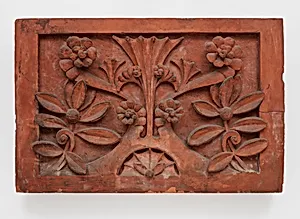
Medium
Terracotta
Dimensions
Not including projecting ornament: 68 × 104.8 × 16.6 cm (26 3/4 × 41 1/4 × 6 1/2 in.)
Classification
architectural fragment
Department
Architecture and Design
Museum
Art Institute of Chicago
Accession Number
46630
Rights
Public Domain
Art Historical Context
Step into the architectural legacy of Chicago's skyscraper era with this striking terracotta spandrel panel from the Rosenfeld Building, crafted by the visionary firm Adler & Sullivan between 1881 and 1882. Spandrels, the triangular spaces between arches or over doors, were prime canvases for ornate decoration in the city's booming commercial landscape after the Great Fire of 1871. This panel, measuring 68 × 104.8 × 16.6 cm, exemplifies the firm's early mastery of terracotta—a durable, moldable clay fired to mimic stone, allowing intricate designs at a fraction of the cost. Adler & Sullivan, led by engineer Dankmar Adler and ornament-obsessed architect Louis Sullivan, pioneered the Chicago School style, blending structural steel frames with exuberant, nature-inspired motifs. Their work bridged Victorian excess and modern simplicity, foreshadowing Art Nouveau. This panel likely featured their signature geometric patterns intertwined with organic flourishes, showcasing Sullivan's mantra "form follows function" through decorative exuberance that enhanced building facades. Tragically demolished in 1958 amid urban renewal, this survivor now resides in the Art Institute of Chicago's Architecture and Design collection. It offers a tactile glimpse into Gilded Age innovation, reminding us how fragile architectural treasures can be—and why preserving fragments like this preserves Chicago's soul.
About the Artist
Adler & Sullivan, Architects · 1883–1896
Adler & Sullivan was the Chicago architectural partnership that laid the conceptual and structural foundations for the modern American skyscraper. Dankmar Adler (1844–1900), a German-born engineer celebrated for his mastery of building acoustics and structural systems, hired Louis Sullivan (1856–1924) in 1879; the two became full partners in 1883. Sullivan had trained at the Massachusetts Institut...