
Spanish Southwest: Hat
c. 1939
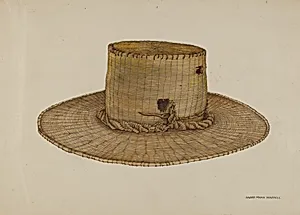
Medium
watercolor, graphite, and colored pencil on paper
Dimensions
overall: 23.7 x 33.5 cm (9 5/16 x 13 3/16 in.)
Classification
Index of American Design
Department
CG-W
Museum
National Gallery of Art, Washington, D.C.
Credit
Index of American Design
Accession Number
1943.8.10269
Rights
Public Domain
Art Historical Context
Harry Mann Waddell's *Spanish Southwest: Hat*c. 1939) is a captivating watercolor, graphite, and colored pencil on paper, measuring 23.7 x 33.5 cm. Created as part of the Index of American Design—a groundbreaking WPA Federal Art Project initiative during the Great Depression—this work meticulously documents a traditional hat from the Spanish-influenced Southwest, likely evoking the vibrant cultural heritage of regions like New Mexico. The Index aimed to celebrate and preserve America's diverse design traditions, from folk crafts to fine arts, employing artists to produce precise, colorful studies of everyday objects. Waddell, a skilled illustrator, masterfully combined graphite for fine lines and details, watercolor for luminous washes, and colored pencil for subtle textures, capturing the hat's form with documentary accuracy and artistic flair. This mixed-media approach was ideal for the project's goal of creating an enduring visual archive. Today, housed in the National Gallery of Art, this piece highlights the fusion of Spanish colonial motifs with American regional identity, offering visitors a window into mid-20th-century efforts to honor overlooked cultural treasures amid economic hardship. A testament to folk artistry's enduring appeal!
About the Artist
Harry Mann Waddell · 1855–present
Harry Mann Waddell (1876–1956) was an American artist born on June 22, 1876, in Ohio, whose career flourished in California after he settled in Los Angeles by 1936. There he established a studio, working as a freelance draftsman while creating fine art in his spare time. His early life and formal training remain not well documented, but by the late 1930s, Waddell had become a key contributor to th...