
Straw Bee Hive
c. 1940
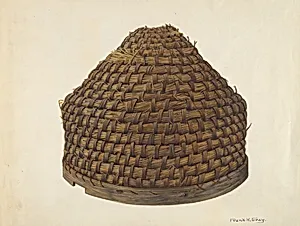
Medium
watercolor, graphite, pen and ink, and gouache on paper
Dimensions
overall: 30.7 x 40.9 cm (12 1/16 x 16 1/8 in.) Original IAD Object: 13 1/4" high; 16" in diameter
Classification
Index of American Design
Department
CG-W
Museum
National Gallery of Art, Washington, D.C.
Credit
Index of American Design
Accession Number
1943.8.8639
Rights
Public Domain
Art Historical Context
**Straw Bee Hive** by Frank Gray, created around 1940, is a rendering of a traditional American folk craft object from the Index of American Design (IAD). This watercolor, graphite, pen and ink, and gouache on paper (30.7 x 40.9 cm) captures a coiled straw beehive, originally 13¼ inches high and 16 inches in diameter Part of a WPA-era Federal Art Project (1935–1942), the IAD commissioned artists to document everyday American designs—from utilitarian tools to decorative arts—preserving cultural heritage amid the Great Depression. Gray's depiction highlights the beehive's organic form and craftsmanship, showcasing rural beekeeping traditions vital to early American agriculture. Straw skeps like this, woven from natural fibers, provided practical hives for honey production and pollination, embodying self-reliant folk ingenuity before modern apiary methods. The mixed-media technique—precise ink lines, graphite underdrawing, vibrant gouache, and subtle watercolor—exemplifies IAD's goal of accurate, colorful reproductions for study and appreciation. Housed in the National Gallery of Art, this piece invites visitors to celebrate the beauty in humble, everyday objects that shaped American life.
About the Artist
Frank Gray · 1889–1962
Frank Gray is an artist whose works are held in institutional collections, though comprehensive biographical information — including birth and death dates, nationality, and artistic training — remains difficult to establish from currently available sources. The relative obscurity of his biographical record is not uncommon among artists who worked outside the major metropolitan centers or the most ...