
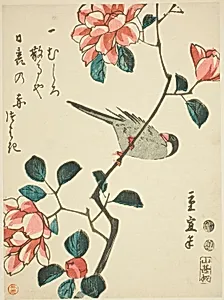
Sparrow on camellia branch
c. 1847/52
Medium
Color woodblock print; koban
Dimensions
22 × 16.3 cm (8 3/4 × 6 3/8 in.)
Classification
woodblock print
Department
Arts of Asia
Museum
Art Institute of Chicago
Accession Number
56217
Rights
Public Domain
Art Historical Context
Discover the delicate charm of *Sparrow on Camellia*, a color woodblock print by Utagawa Hiroshige II (Shigenobu), around 1847–52. Hiroshige II, adopted son and pupil of the famed landscape master Utagawa Hiroige I, carried forward the Utagawa school's ukiyo-e tradition—Japan's vibrant "pictures of the floating world" that captured fleeting beauty in everyday life. This intimate koban-format print (a compact 22 × 16.3 cm) exemplifies the genre's accessibility, designed for personal enjoyment rather than grand display. In the late Edo period, amid Japan's isolationist sakoku policy, woodblock prints like this one democratized art through precise carving and layering of color blocks, yielding rich hues from vegetable dyes. The sparrow perched on a blooming camellia branch evokes kacho-e (birds-and-flowers) motifs, celebrating nature's quiet poetry. Camellias, with their bold winter petals, symbolized transience, while the sparrow added a touch of lively realism—Hiroshige II's keen observation shining through subtle textures and dynamic composition. Housed in the Art Institute of Chicago's Arts of Asia collection, this work highlights ukiyo-e's enduring influence on global art, from Impressionism to modern design. A perfect gem for pondering harmony in simplicity!
About the Artist
Utagawa Hiroshige II (Shigenobu) · 1826–1869
Utagawa Hiroshige II, born Suzuki Chinpei in 1826, was one of the most accomplished ukiyo-e artists of mid-nineteenth century Japan. He entered the studio of the celebrated landscape master Utagawa Hiroshige I — known for his iconic series "The Fifty-three Stations of the Tokaido" — and proved himself the most talented of the elder artist's few students. So highly regarded was the young pupil that...