
Specimen
Unknown Artist
19th century
Medium
Needle lace
Dimensions
L. 11 1/2 x W. 4 1/2 inches 29.2 x 11.4 cm
Classification
Textiles-Laces
Culture
Belgian, Brussels
Department
European Sculpture and Decorative Arts
Museum
Metropolitan Museum of Art, New York, NY
Credit
Purchase by subscription, 1909
Accession Number
09.68.317
Rights
Public Domain
Tags
Art Historical Context
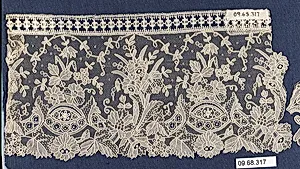
This delicate *Specimen* of needle lace, crafted in Brussels, Belgium during the 19th century exemplifies the city's renowned lace-making tradition. Measuring 11½ by 4½ inches (29.2 x 11.4 cm), this rectangular piece features intricate floral motifs—a hallmark of Brussels lace—showcasing the exquisite detail prized in European decorative arts. Acquired by the Metropolitan Museum of Art in 9 through a public subscription purchase, it now resides in the Department of European Sculpture and Decor Arts, classified among textiles-laces. Needle lace, or *point de Bruxelles*, is a labor-intensive technique where artisans individually stitch fine linen threads onto a temporary paper pattern using a needle, creating a freeform, sculptural fabric without a supporting weave. In the 19th century, Brussels remained a global epicenter for this craft, even as industrialization challenged handmade traditions. Workshops produced such "specimens" as pattern samples for clients, fashion houses, or collectors, highlighting motifs like blooming flowers that symbolized elegance and nature's beauty. As a cultural artifact, this anonymous work reflects Belgium's economic and artistic heritage, where lace was both a luxury export and a symbol of skilled female labor. Visitors will appreciate its tactile intricacy up close, a testament to the patience and precision of 19th-century lacemakers.