
Specimen
Unknown Artist
19th century
Medium
Needle lace
Dimensions
L. 13 x W. 7 inches 33.0 x 17.8 cm
Classification
Textiles-Laces
Culture
Belgian, Brussels
Department
European Sculpture and Decorative Arts
Museum
Metropolitan Museum of Art, New York, NY
Credit
Purchase by subscription, 1909
Accession Number
09.68.318
Rights
Public Domain
Tags
Art Historical Context
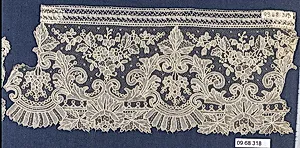
Behold the delicate beauty of *Specimen*, a 19th-century needle lace masterpiece Brussels, Belgium, now housed in the Metropolitan Museum Art's Department of European Sculpture and Decor Arts. Measuring 13 by 7 inches (33 x 17.8 cm), this work was acquired through public subscription in 1909, undersc its early recognition as a treasure of textile artistry. Brussels lace, a hallmark of Belgian craftsmanship, flourished in the 19th as a luxury export, blending fine artistry with technical innovation. Crafted using the needle lace technique—where threads are meticulously stitched onto a paper pattern by hand—this piece features intricate motifs of flowers and leaves. The method produces a sculptural, raised quality, with each petal and vein rendered in ethereal transparency. Unlike bobbin lace, needle lace allowed lacemakers unparalleled freedom for organic, naturalistic designs, making Brussels renowned for its opulent, lifelike florals that adorned elite wardrobes and interiors across Europe. As a classified lace textile, *Specimen* highlights the cultural prestige of Brussels lacemaking, a guild-dominated trade that symbolized refinement and skill. Though titled simply "Specimen," it invites us to marvel at the anonymous artist's patience, transforming fragile threads into enduring elegance—a testament to 19th-century decorative arts' fusion of utility and splendor.