
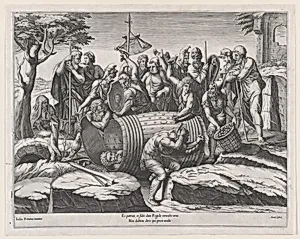
Speculum Romanae Magnificentiae: Attilius Regulus in a Barrel
late 16th century
Medium
Engraving
Dimensions
sheet: 14 x 17 5/16 in. (35.5 x 44 cm) mount: 13 1/16 x 16 3/8 in. (33.1 x 41.6 cm)
Classification
Prints
Department
Drawings and Prints
Museum
Metropolitan Museum of Art, New York, NY
Credit
Harris Brisbane Dick Fund, 1941
Accession Number
41.72(3.80)
Rights
Public Domain
Tags
Art Historical Context
Behold the dramatic engraving *Speculum Romanae Magniae: Attilius Reg in a Barrel*, a 16th-century print the Metropolitan Museum of Art Drawings and Prints collection. work captures a legendary episode from ancient Roman history: Marcus Atilius Reg, a heroic consul captured by the Carthaginians during the Punic War (264–241 BCE). According to tradition, after being sent to Rome on parole to negotiate peace, Regulus honorably returned to Carthage, where his enemies reportedly tortured him by enclosing him in a barrel studded with nails and rolling it down a hill—a vivid symbol of Roman stoicism and virtue. Crafted as part of Antonio Lafreri's renowned anthology *Speculum Romanae Magnificentiae* ("Mirror of Roman Magnificence"), this engraving draws on designs possibly by Mannerist master Giulio Romano and was executed by skilled engraver Diana Scultori, one of the few prominent female printmakers of the era. Measuring about 14 x 17 inches on its sheet, the intaglio technique allowed for intricate details and widespread dissemination, fueling Renaissance fascination with classical antiquity. Lafreri's series, unbound and customizable, became a bestseller among collectors, blending historical moralizing with artistic virtuosity. This piece, acquired through the Harris Brisbane Dick Fund in 1941, exemplifies how 16th-century Europeans revived Roman tales to inspire their own cultural identity, reminding us of art's power to immortalize tales of courage amid brutality.