
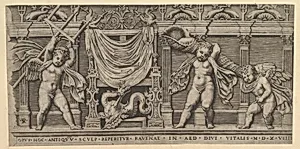
Speculum Romanae Magnificentiae: Bas-Relief with Three Cupids
Medium
Engraving
Dimensions
mount: 11 x 16 7/8 in. (28 x 42.8 cm) sheet: 6 5/8 x 13 3/8 in. (16.8 x 34 cm)
Classification
Prints
Department
Drawings and Prints
Museum
Metropolitan Museum of Art, New York, NY
Credit
Harris Brisbane Dick Fund, 1941
Accession Number
41.72(2.147)
Rights
Public Domain
Tags
Art Historical Context
Welcome to the Metropolitan Museum of Art's Drawings and Prints department, where we encounter *Speculum Romanaeificentiae: Bas-Relief with Three Cupids*, exquisite 1519 engraving by Marcoente after a design by the High Renaissance master Raphael (Raffa Sanzio da Urbino). Measuring about 6⅝ × 13⅜ inches on the sheet, this print the playful frolic of three Cupids—cherubic figures embodying love and desire from ancient Roman mythology—in a detailed reproduction of a classical bas-relief sculpture. The *Speculum Romanae Magnificentiae* ("Mirror of Roman Magnificence") was an ambitious 16th-century series of prints celebrating Rome's ancient wonders, blending Renaissance artistry with fervent antiquarianism. Raphael, renowned for his harmonious compositions and classical ideals, oversaw such projects in his workshop, influencing engravers like Dente to meticulously translate sculptures into printable form. Engraving's fine lines allowed precise replication of stone textures, textures, and intricate details, making these elusive Roman artifacts accessible to scholars, artists, and collectors across Europe. This work exemplifies the Renaissance obsession with antiquity, fueling the revival of classical motifs in painting, architecture, and decorative arts. Imagine Cupids dancing amid rediscovered ruins— a charming nod to eternal themes of joy and eros that bridged ancient Rome and the modern world. (198 words)
About the Artist
Marco Dente|Raphael (Raffaello Sanzio or Santi) · 1515–1527
Marco Dente (died 1527), also known as Marco da Ravenna, was among the most accomplished printmakers working in Rome during the High Renaissance, a period that witnessed an extraordinary flowering of engraving as both a reproductive and an independent artistic medium. Little is known of his early training, but by the second decade of the sixteenth century he had established himself in the orbit of...