
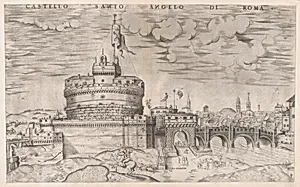
Speculum Romanae Magnificentiae: Castello Sant' Angelo
16th century
Medium
Engraving
Dimensions
sheet: 12 3/16 x 19 11/16 in. (31 x 50 cm) mount: 19 1/8 x 26 in. (48.6 x 66 cm)
Classification
Prints
Department
Drawings and Prints
Museum
Metropolitan Museum of Art, New York, NY
Credit
Harris Brisbane Dick Fund, 1941
Accession Number
41.72(3.42)
Rights
Public Domain
Tags
Art Historical Context
Step into the timeless allure of Renaissance Rome with *Speculum Romanae Magniae: Castello Sant'*, a 16th-century engraving from the *Speculum Romanaeificentiae* series. Published by Antonio Salamanca and created by an anonymous artist, this print captures the imposing Castel Sant'Angelo, a multifaceted landmark that began as Emperor Hadrian's mausoleum the 2nd century before evolving into a medieval fortress and papal stronghold. The detailed depiction highlights its cylindrical form, battlements, flags fluttering atop towers, and commanding presence along the Tiber River, evoking Rome's layered history of imperial glory and defensive might. As part of the *Speculum* ("Mirror of Roman Magnificence"), a vast anthology of over 600 prints compiled by Antwerp publisher Antonio Lafreri from the 1540s to 1570s, this work reflects the era's fervent antiquarianism. Collectors prized these affordable engravings for their precise architectural renderings, blending ancient ruins with contemporary views to celebrate Rome's enduring splendor amid the Renaissance revival of classical antiquity. Engraving's fine lines allowed for intricate details—from stone textures to distant cityscapes—making it an ideal medium for disseminating Rome's wonders across Europe. Housed in the Metropolitan Museum of Art's Drawings and Prints department, this sheet (12 3/16 x 19 11/16 in.) invites visitors to ponder how such prints fueled the imagination of artists, architects, and travelers, bridging antiquity and the modern world.
About the Artist
Anonymous|Antonio Salamanca
In the vast tapestry of art history, "Anonymous" stands not as a singular individual but as a collective designation for countless unidentified creators whose works have endured across millennia. These artists, spanning prehistoric cave painters to medieval illuminators and folk craftsmen, produced the foundational layers of human visual culture. Prior to the Renaissance, when individual fame emer...