
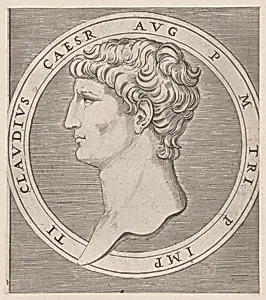
Speculum Romanae Magnificentiae: Claudius, from The Twelve Caesars
ca. 1500–1534
Medium
Engraving; second state of three
Dimensions
mount: 7 5/16 x 16 3/4 in. (18.5 x 42.5 cm) sheet: 5 7/8 x 6 5/16 in. (15 x 16 cm)
Classification
Prints
Department
Drawings and Prints
Museum
Metropolitan Museum of Art, New York, NY
Credit
Harris Brisbane Dick Fund, 1941
Accession Number
41.72(3.86)
Rights
Public Domain
Tags
Art Historical Context
Behold the regal profile of Emperor Claudius, captured in this exquisite engraving by Marcantonio Raimondi, pivotal figure in Renaissance printmaking. Titled *Claudius, from The Caesars* and part of the renowned *Speculum Romanaeificentiae* series (. 1500–153), this second-state measures a compact 5 7/8 x 6 5/16 inches on its sheet. Raimondi, celebrated for his precise reproductions of designs by Raphael and classical motifs, masterfully renders the Roman leader in, evoking ancient coins and busts that symbolized imperial power. The *Speculum Romanae Magnificentiae*, or "Mirror of Roman Magnificence," was a lavish collection of prints produced in 16th-century Rome, showcasing the city's antiquities to fuel the Renaissance obsession with classical antiquity. Claudius (r. 41–54 CE), known for expanding the empire and engineering feats like the Claudian Aqueduct, here embodies Rome's enduring legacy. Raimondi's engraving technique—incising lines into a copper plate for rich tonal depth—allowed these images to be widely disseminated, making elite art accessible to collectors across Europe. This Harris Brisbane Dick Fund acquisition at The Metropolitan Museum of Art highlights engraving's revolutionary role in democratizing knowledge of history and heroism, inviting us to ponder the timeless allure of Roman grandeur.
About the Artist
Marcantonio Raimondi · 1475–1534
Marcantonio Raimondi (c. 1480–1534), born near Bologna, Italy, emerged as one of the Renaissance's premier engravers, revolutionizing printmaking through his mastery of reproductive techniques. He trained in the workshop of the goldsmith, painter, and niellist Francesco Francia, whose influence is evident in his early engravings, such as the goldsmith-like shading in *Pyramus and Thisbe* (1505), h...