
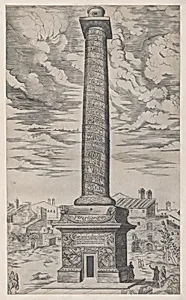
Speculum Romanae Magnificentiae: Column of Trajan
Medium
Engraving
Dimensions
mount: 22 1/8 x 16 7/8 in. (56.2 x 42.8 cm) sheet: 19 5/16 x 11 9/16 in. (49 x 29.4 cm)
Classification
Prints
Department
Drawings and Prints
Museum
Metropolitan Museum of Art, New York, NY
Credit
Harris Brisbane Dick Fund, 1941
Accession Number
41.72(1.97)
Rights
Public Domain
Tags
Art Historical Context
This enchanting engraving, titled *Speculum Romanae Magnificentiae: Column of Tra*, captures the majestic spiral reliefs of Rome's iconic Trajan's Column, a masterpiece of ancient Roman engineering from around 113 CE. Produced in 1544 by publisher Antonio Lafreri ( possibly an anonymous collaborator), it forms part of the renowned *Speculum Romanaeificentiae*—a 16th-century collection of over 500 prints documenting Rome's ancient wonders. the Renaissance, such images fueled a revival of classical antiquity, inspiring architects, artists, and scholars amid the city's rediscovery. As an engraving on a sheet measuring about 19 x 11 inches, the print exemplifies the era's innovative printmaking techniques. Fine lines and meticulous detail allowed precise reproduction of the column's intricate carvings—depicting Emperor Trajan's Dacian Wars in a continuous narrative band rising 100 feet skyward. Lafreri's publication made these distant monuments accessible to Europe's elite, bridging ancient imperial glory with humanist curiosity. Housed in the Metropolitan Museum of Art's Drawings and Prints department, this work highlights engraving's role in cultural preservation, turning stone into portable history for armchair explorers and Grand Tour travelers alike. A testament to Rome's enduring allure!
About the Artist
Antonio Lafreri|Anonymous · 1507–1577
Antonio Lafreri, born Antoine du Pérac Lafréry around 1512 in Orgelet in the County of Burgundy (modern-day France), emerged as one of the most influential print publishers of the 16th century after settling in Rome around 1540. His early life and training remain sparsely documented, with no records of specific teachers or art schools; he arrived in the Eternal City as an engraver, producing works...