
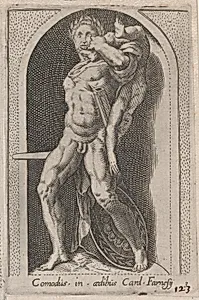
Speculum Romanae Magnificentiae: Comodus (Comodus in aedibus Card. Farnesij)
16th century
Medium
Engraving
Dimensions
sheet: 16 5/8 x 13 1/8 in. (42.3 x 33.3 cm) plate: 4 15/16 x 3 1/8 in. (12.5 x 8 cm)
Classification
Prints
Department
Drawings and Prints
Museum
Metropolitan Museum of Art, New York, NY
Credit
Harris Brisbane Dick Fund, 1941
Accession Number
41.72(2.160)
Rights
Public Domain
Tags
About this artwork
Speculum Romanae Magnificentiae: Comodus (Comodus in aedibus Card. Farnesij) by Anonymous|Philippe Thomassin|Antonio Lafreri, 16th century. Created in Engraving, this work exemplifies the artistic practices and cultural values of its period. The piece reflects the technical skills and aesthetic sensibilities characteristic of its historical and cultural context. As part of the Drawings and Prints collection, it contributes to our understanding of artistic development and cultural expression. The...
Art Historical Context
This 16th-century engraving, titled *Speculum Romana Magnificentiae: Com (Comodus in aedibus Card. Farnes)*, hails from Antonio Lafreri's renowned anthology of Roman antiquities and views, a "mirror" showcasing the Eternal City's grandeur. Published in Rome, the *Speculum* compiled prints by various artists, including possible contributions from Philippe Thomassin anonymous engravers, to celebrate classical heritage during the Renaissance. Here, it depicts Commodus—likely a ancient statue of the Roman emperor—in the opulent Palazzo Farnese, residence of Cardinal Alessandro Farnese, blending antiquity with papal patronage. As an engraving, the work highlights the medium's precision and reproducibility, allowing detailed dissemination of Rome's sculptures to scholars and collectors across Europe. The small plate size (4 15/16 x 3 1/8 in.) on a larger sheet reflects practical formats for albums, while the male nude subject underscores Renaissance fascination with classical anatomy and heroism. Housed in the Metropolitan Museum of Art's Drawings and Prints department, this piece serves as both aesthetic gem and historical document, capturing 16th-century reverence for Rome's past amid the era's cultural revival. It invites visitors to ponder how such prints fueled the Grand Tour and humanist scholarship.
About the Artist
Anonymous|Philippe Thomassin|Antonio Lafreri
In the vast tapestry of art history, "Anonymous" stands not as a singular individual but as a collective designation for countless unidentified creators whose works have endured across millennia. These artists, spanning prehistoric cave painters to medieval illuminators and folk craftsmen, produced the foundational layers of human visual culture. Prior to the Renaissance, when individual fame emer...