
Speculum Romanae Magnificentiae: Daican War
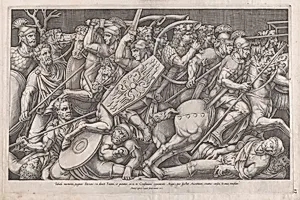
Medium
Engraving; second state of two (Robert-Dumesnil)
Dimensions
sheet: 14 x 19 1/2 in. (35.5 x 49.5 cm) plate: 11 13/16 x 18 1/8 in. (30 x 46 cm)
Classification
Prints
Department
Drawings and Prints
Museum
Metropolitan Museum of Art, New York, NY
Credit
Harris Brisbane Dick Fund, 1941
Accession Number
41.72(2.117)
Rights
Public Domain
Tags
Art Historical Context
This engraving, titled *Speculum Romanae Magnificentiae: Daican War*, was created in 1553 by engraver Nicolas Beatrizet and published by Antonio Lafreri. Measuring roughly 30 by 46 centimeters on the plate, it captures a dynamic battle scene filled with Roman soldiers on horseback, wielding shields and spears against their foes. As part of Lafreri’s ambitious *Speculum Romanae Magnificentiae* series, the print belongs to a celebrated collection that documented the grandeur of ancient Rome through detailed reproductions of architecture, sculpture, and historical events. Produced during the height of the Renaissance, the work reflects a renewed European fascination with classical antiquity. Lafreri’s project allowed viewers across the continent to study Roman history and art without traveling to Italy, making these images both educational tools and objects of cultural prestige. Beatrizet’s precise line work highlights the movement of horses and the clash of weapons, demonstrating the engraving medium’s ability to convey drama and detail at a time when prints were the primary means of visual communication. The second state of this engraving underscores its lasting appeal, as later impressions continued to circulate among collectors and scholars. Today, it offers museum visitors a window into how 16th-century artists interpreted and celebrated Rome’s military past.
About the Artist
Antonio Lafreri|Nicolas Beatrizet · 1507–1577
Antonio Lafreri, born Antoine du Pérac Lafréry around 1512 in Orgelet in the County of Burgundy (modern-day France), emerged as one of the most influential print publishers of the 16th century after settling in Rome around 1540. His early life and training remain sparsely documented, with no records of specific teachers or art schools; he arrived in the Eternal City as an engraver, producing works...