
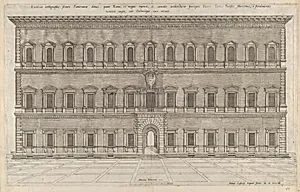
Speculum Romanae Magnificentiae: Exterior of the Farnese Palace
Medium
Engraving; first state of two
Dimensions
sheet: 17 1/2 x 22 1/16 in. (44.5 x 56 cm) plate: 13 1/4 x 21 1/4 in. (33.6 x 54 cm)
Classification
Prints
Department
Drawings and Prints
Museum
Metropolitan Museum of Art, New York, NY
Credit
Harris Brisbane Dick Fund, 1941
Accession Number
41.72(3.48)
Rights
Public Domain
Tags
Art Historical Context
This exquisite engraving, *Speculum Romanae Magniae: Exterior of theese Palace* (1549), captures the grand facade of one of Rome's most iconic Renaissance palaces. Created by engraver Nicolas Beatrizet and by Antonio Lafreri it belongs to the renowned *Speculum Romanae Magniae*—a celebrated 16th-century anthology of over 500 prints that served as a "mirror" reflecting Rome's ancient ruins and modern splendor. These images fueled the era's fascination with classical antiquity, attracting artists, scholars, and pilgrims to the Eternal City. The Farnese Palace, designed by architects like Antonio da Sangallo the Younger and later refined by Michelangelo, epitomized Renaissance opulence with its rusticated stonework and monumental scale. Beatrizet's precise engraving technique—incising intricate lines into a copper plate for inking and printing—allowed for remarkable detail in this first-state impression, measuring about 13¼ x 21¼ inches on the plate. As a print, it democratized access to Rome's architectural marvels, transforming elite wonders into portable souvenirs for Europe's cultured elite. Housed in the Metropolitan Museum of Art's Drawings and Prints department, this work highlights the cultural renaissance in Rome, blending historical reverence with innovative printmaking that preserved and popularized the city's timeless magnificence.
About the Artist
Nicolas Beatrizet|Antonio Lafreri · 1515–1566
Nicolas Beatrizet, born around 1515 in Lunéville, Lorraine (then part of the Holy Roman Empire), emerged as one of the most prolific French engravers of the 16th century. Little is known about his early life and training, with no records of specific teachers or apprenticeships, though regional influences from German and Italian printmaking likely shaped his skills before he arrived in Rome around ...