
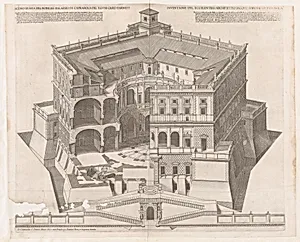
Speculum Romanae Magnificentiae: Farnese Palace
16th century
Medium
Engraving
Dimensions
sheet: 15 1/16 x 18 11/16 in. (38.2 x 47.4 cm) plate: 15 1/16 x 17 9/16 in. (38.2 x 44.6 cm) mount: 17 1/2 x 21 7/8 in. (44.5 x 55.6 cm)
Classification
Prints
Department
Drawings and Prints
Museum
Metropolitan Museum of Art, New York, NY
Credit
Harris Brisbane Dick Fund, 1941
Accession Number
41.72(3.54)
Rights
Public Domain
Tags
Art Historical Context
Step into the grandeur of Renaissance Rome with *Speculum Romanae Magnificentiae: Farnese Palace*, a stunning 16th-century engraving by Francesco Villamena. This print is part of the celebrated *Speculum Romanae Magnificentiae* ("Mirror of Roman Magnificence") series, a collection of images that captured the Eternal City's ancient ruins, palaces, and modern marvels for eager collectors across Europe. Villamena, a skilled Italian engraver, meticulously rendered the imposing Farnese Palace—one of Rome's most opulent residences, built for the powerful Farnese family by architects like Antonio da Sangallo the Younger and later refined by Michelangelo. Engraving, the medium here, allowed for intricate detail on a copper plate, inked and pressed onto paper to produce precise, reproducible images measuring about 15 x 18 inches on its sheet. These prints were prized souvenirs for Grand Tour travelers, blending architectural accuracy with artistic flair to evoke Rome's timeless splendor. Housed in the Metropolitan Museum of Art's Drawings and Prints department (acquired via the Harris Brisbane Dick Fund in 1941), this work highlights how 16th-century printmaking democratized access to Italy's cultural treasures, preserving the palaces of Rome for posterity.
About the Artist
Francesco Villamena · 1565–1624
Francesco Villamena (ca. 1565–1624), born in Assisi, emerged as one of the foremost Italian engravers of the late Mannerist era, renowned for his reproductive prints that disseminated the masterpieces of High Renaissance artists across Europe. He studied under the Dutch engraver Cornelis Cort in Rome, where he arrived during the papacy of Sixtus V (1585–1590), honing his technique by copying Cort'...