
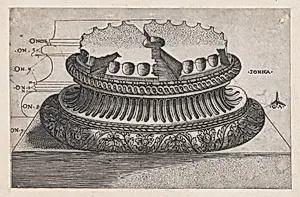
Speculum Romanae Magnificentiae: Ionic base
ca. 1537
Medium
Engraving
Dimensions
sheet: 4 1/2 x 6 7/8 in. (11.5 x 17.5 cm) mount: 8 1/16 x 8 7/16 in. (20.5 x 21.5 cm)
Classification
Prints
Department
Drawings and Prints
Museum
Metropolitan Museum of Art, New York, NY
Credit
Harris Brisbane Dick Fund, 1941
Accession Number
41.72(2.17)
Rights
Public Domain
Tags
Art Historical Context
This engraving, titled *Speculum Romanae Magnificentiae: Ionic base*, captures a detailed study of classical architectural ornament from ancient Rome. Created around 1537 by the printmaker known as Monogrammist G.A. (often identified by his monogram and a caltrop symbol), the work belongs to a celebrated series of prints that documented the grandeur of Roman ruins and monuments. Measuring just 4½ by 6⅞ inches, the delicate engraving showcases the elegant profile of an Ionic base, with its precise moldings and subtle curves rendered through fine, controlled lines characteristic of the medium. During the Renaissance, such prints played a vital role in reviving interest in classical antiquity. Collectors and architects across Europe relied on these affordable images to study the proportions and details of ancient structures, helping to shape the emerging language of Renaissance architecture. The *Speculum* series, meaning “Mirror of Roman Magnificence,” functioned almost like a visual encyclopedia, preserving and disseminating knowledge of buildings that were rapidly deteriorating. As a print in the Metropolitan Museum’s collection, this work highlights the technical artistry of engraving while underscoring the period’s deep admiration for Rome’s enduring legacy. Its modest size belies its influence on generations of artists and builders seeking to reconnect with the classical past.
About the Artist
Monogrammist G.A. & the Caltrop · 1535–1535
**Monogrammist G.A. with the Caltrop**, an enigmatic Italian engraver active in Rome during the 1530s and 1540s, remains one of the shadowy figures of the Renaissance print world. Identified solely by his monogram "G.A." accompanied by a distinctive caltrop symbol—a spiked iron ball used in warfare—little is known of his personal life or training. His early years are not well documented, and no te...