
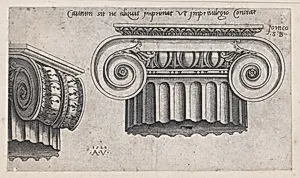
Speculum Romanae Magnificentiae: Ionic Capital
Medium
Engraving
Dimensions
sheet: 4 1/4 x 7 5/16 in. (10.8 x 18.6 cm)
Classification
Prints
Department
Drawings and Prints
Museum
Metropolitan Museum of Art, New York, NY
Credit
Harris Brisbane Dick Fund, 1941
Accession Number
41.72(2.14)
Rights
Public Domain
Tags
Art Historical Context
Created in 1528 by the Italian engraver Agostino Veneziano, this delicate print belongs to the ambitious series *Speculum Romanae Magnificentiae* (“Mirror of Roman Magnificence”). The project gathered precise reproductions of ancient Roman architecture so that artists, architects, and collectors across Europe could study the classical past without traveling to Rome. Veneziano, active in the vibrant printmaking circles of Renaissance Italy, brought exceptional clarity and linear finesse to his plates, allowing every curve of the Ionic capital’s volutes and the crisp acanthus leaves beneath them to be appreciated at intimate scale. The Ionic capital itself—characterized by its elegant scroll-like volutes—exemplifies one of the three canonical orders of Greek and Roman architecture. By isolating and enlarging this single ornamental element, Veneziano transformed a functional architectural detail into a portable lesson in proportion and ornament. Such prints helped fuel the Renaissance revival of classical design, influencing buildings from country villas to grand civic monuments throughout the sixteenth century. Measuring just over four by seven inches, the engraving rewards close looking: fine parallel lines model the three-dimensional form while subtle hatching suggests the play of light across stone. Today housed in the Metropolitan Museum’s collection, it remains a vivid reminder of how Renaissance printmakers turned ancient ruins into enduring sources of inspiration.