
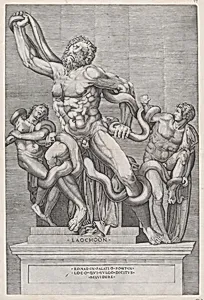
Speculum Romanae Magnificentiae: Laocoon
16th century
Medium
Engraving
Dimensions
sheet: 22 1/16 x 16 15/16 in. (56.1 x 43 cm) plate: 19 3/16 x 12 11/16 in. (48.7 x 32.2 cm)
Classification
Prints
Department
Drawings and Prints
Museum
Metropolitan Museum of Art, New York, NY
Credit
Harris Brisbane Dick Fund, 1941
Accession Number
41.72(2.77)
Rights
Public Domain
Tags
Art Historical Context
Welcome to the Metropolitan Museum of Art's Drawings and Prints department, where you'll find *Speculum Romanae Magnificent: Laocoon*, a striking 16th-century engraving French artist Nicolas Beatrizet. This-scale print (sheet: 22 1/16 x 16 15/16 in.) captures the dramatic torment of the ancient Laocoön statue—a Trojan priest and his sons entwined by massive sea serpents. Beatrizet, active in Rome, masterfully reproduced this iconic Hellenistic sculpture, discovered in 1506, using the precise intaglio technique of engraving. By incising lines into a metal plate and inking them, he achieved intricate details in the muscular male nudes and writhing forms, making the image leap off the page. Part of the renowned *Speculum Romanae Magnificentiae* ("Mirror of Roman Magnificence"), a vast series of over 500 prints published in Rome from the 1540s to 1600s, this work served as a visual encyclopedia of ancient Roman antiquities. It democratized access to masterpieces for artists, scholars, and collectors across Europe, fueling the Renaissance fascination with classical antiquity. The Laocoön itself profoundly influenced figures like Michelangelo, symbolizing heroic struggle and emotional intensity. Beatrizet's engraving not only preserves the sculpture's raw power but also highlights engraving's role in art dissemination—affordable multiples that spread humanist ideals. Acquired through the Harris Brisbane Dick Fund in 1941, it's a testament to Rome's enduring allure. Gaze closely at those serpents' coils and tensed limbs for a visceral brush with antiquity!
About the Artist
Nicolas Beatrizet · 1515–1566
Nicolas Beatrizet, born around 1515 in Lunéville, Lorraine (then part of the Holy Roman Empire), emerged as one of the most prolific French engravers of the 16th century. Little is known about his early life and training, with no records of specific teachers or apprenticeships, though regional influences from German and Italian printmaking likely shaped his skills before he arrived in Rome around ...