
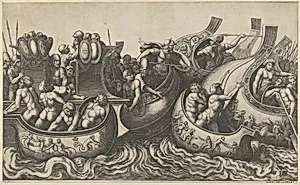
Speculum Romanae Magnificentiae: Naval Battle
16th century
Medium
Engraving
Dimensions
sheet: 9 5/8 x 15 11/16 in. (24.4 x 39.9 cm) mount: 12 1/2 x 16 3/4 in. (31.8 x 42.6 cm)
Classification
Prints
Department
Drawings and Prints
Museum
Metropolitan Museum of Art, New York, NY
Credit
Harris Brisbane Dick Fund, 1941
Accession Number
41.72(2.121)
Rights
Public Domain
Tags
Art Historical Context
Behold the dynamic engraving *Speculum Romanae Magnificentiae: Naval Battle*, a 16th-century masterpiece from renowned print series compiled by publisher Antonio Lafreri.ributed to Mannerist artist Giulio Romano for the design, with engraving by the skilled Master of the Die, print captures the grandeur of ancient Rome through a thrilling naval clash. Part of Lafreri's "Mirror Roman Magnificence"— celebrated anthology of over 600 views, antiquities, and battle scenes—this work reflects the Renaissance fascination with classical antiquity, serving as both artistic treasure and historical document. Measuring nearly 10 by 16 inches on its sheet, the engraving bursts with energy: soldiers wielding spears clash amid boats, their muscular, male nude forms evoking heroic ideals from Greco-Roman sculpture. Engraving's fine lines allowed for intricate details, from churning waves to fierce combat, making these affordable prints popular among collectors across Europe. Housed in the Metropolitan Museum of Art's Drawings and Prints department (Harris Brisbane Dick Fund, 1941), it exemplifies how 16th-century artists revived ancient triumphs to inspire their era's patrons. This piece not only showcases technical prowess in printmaking but also underscores Rome's enduring legacy of military might, inviting visitors to ponder the timeless drama of battle on the high seas.
About the Artist
Giulio Romano|Antonio Lafreri|Master of the Die · 1499–1546
Giulio Romano (c. 1499–1546) was the most gifted pupil of Raphael and one of the founding figures of Mannerism, the style that succeeded the High Renaissance in Italy. Born Giulio Pippi in Rome, he entered Raphael's workshop as a boy and proved so talented that by the time of Raphael's death in 1520 he was effectively running the studio and overseeing the completion of major unfinished commissions...