
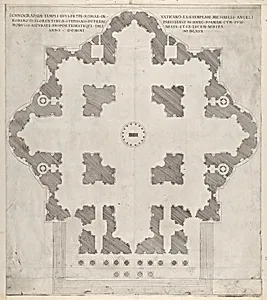
Speculum Romanae Magnificentiae: Plan of St. Peter's
1569
Medium
Engraving
Dimensions
sheet: 18 9/16 x 16 5/16 in. (47.2 x 41.5 cm)
Classification
Prints
Department
Drawings and Prints
Museum
Metropolitan Museum of Art, New York, NY
Credit
Harris Brisbane Dick Fund, 1941
Accession Number
41.72(3.29)
Rights
Public Domain
Tags
About this artwork
"Speculum Romanae Magnificentiae: Plan of St. Peter's" by Etienne DuPérac (French) from 1569 represents an important work in prints. Created in engraving, this work demonstrates technical skill and artistic vision. As a print, it demonstrates reproductive techniques of the period. The artwork reflects aesthetic values of its time, offering insight into artistic practices and cultural context. It demonstrates the evolution of artistic expression and technical methods during this period. Held in a...
Art Historical Context
Etienne DuPérac’s 1569 engraving, “Plan of St. Peter’s,” belongs to the ambitious print series *Speculum Romanae Magnificentiae*, which documented the architectural wonders of Rome for an international audience. Created at a time when St. Peter’s Basilica was still under construction, the print records the evolving design of one of the Renaissance’s most important building projects. As an engraving, it allowed precise architectural details to be reproduced and circulated across Europe, transforming a working plan into an object of study and admiration. DuPérac, a French artist working in Italy, employed the medium’s fine lines to convey both the grandeur of the basilica’s scale and the intricate geometry of its layout. Engravings like this one served not only as records but also as tools for architects and patrons who could not travel to Rome, highlighting the growing role of printmaking in shaping architectural knowledge during the sixteenth century. Today, this impression in the Metropolitan Museum’s collection continues to offer viewers a window into Renaissance Rome’s creative energy and technical innovation. Its careful rendering of space and structure invites us to appreciate both the building’s spiritual aspirations and the artistry required to preserve its image for future generations.
About the Artist
Etienne DuPérac · 1535–1604
Comment on works: architect; painter