
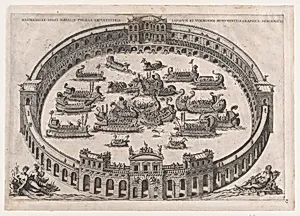
Speculum Romanae Magnificentiae: Roman Naval Battle
16th century
Medium
Engraving
Dimensions
sheet: 13 9/16 x 19 1/8 in. (34.5 x 48.5 cm) plate: 12 3/8 x 18 1/8 in. (31.5 x 46 cm)
Classification
Prints
Department
Drawings and Prints
Museum
Metropolitan Museum of Art, New York, NY
Credit
Harris Brisbane Dick Fund, 1941
Accession Number
41.72(1.72)
Rights
Public Domain
Tags
Art Historical Context
Welcome to the Metropolitan Museum of Art's Drawings and Prints department, where 16th-century engraving *Speculum Romanae Magnificent: Roman Naval Battle*, the epic clash of ancient Roman naval forces. Part of the renowned *Speculum Romanae Magniae* ("Mirror of Roman Magnific") series compiled by publisher Antonio Lafreri, exemplifies Renaissance fascination with Rome's imperial past. These prints, produced in Rome from the 1540s onward, celebrated the city's ruins, triumphs, and legends, serving as visual "mirrors" for scholars, travelers, and collectors across Europe. The scene bursts with dynamic energy: towering ships ram through churning waves, warriors in dynamic poses—many nude, evoking classical ideals of the heroic male and female form—engage in fierce combat. Tags like "Battles," "Navy," "Male Nudes," and "Female Nudes" highlight its blend of historical reenactment and artistic nudity, drawing from ancient sources like Roman coins and texts to romanticize naval victories, possibly alluding to triumphs over Carthage or pirates. Crafted anonymously via engraving—a precise intaglio technique where lines incised into a metal plate hold ink for detailed reproduction—this 12⅜ × 18⅛-inch plate (on a larger sheet) allowed widespread dissemination of Rome's grandeur. Acquired through the Harris Brisbane Dick Fund in 1941, it invites us to ponder how 16th-century artists revived antiquity to inspire their own era's ambitions.
About the Artist
Anonymous
In the vast tapestry of art history, "Anonymous" stands not as a singular individual but as a collective designation for countless unidentified creators whose works have endured across millennia. These artists, spanning prehistoric cave painters to medieval illuminators and folk craftsmen, produced the foundational layers of human visual culture. Prior to the Renaissance, when individual fame emer...