
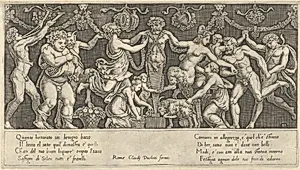
Speculum Romanae Magnificentiae: Sacrifice to Priapus
Medium
Engraving
Dimensions
sheet: 10 1/16 x 12 1/16 in. (25.5 x 30.6 cm) plate: 6 5/16 x 11 1/4 in. (16 x 28.5 cm)
Classification
Prints
Department
Drawings and Prints
Museum
Metropolitan Museum of Art, New York, NY
Credit
Harris Brisbane Dick Fund, 1941
Accession Number
41.72(2.150)
Rights
Public Domain
Tags
Art Historical Context
"Speculum Romanae Magniae: Sacrifice to Pri" is a captivating 16th-century engraving Antonio Lafreri's renowned print series, *Speculum Romanae Magniae* ("Mirror of Roman Magnificence"). Compiled in Rome during the Renaissance, this collection celebrated the grandeur of ancient Rome through images of architecture, antiquities, and mythology. Attributed to a stellar collaboration—including designs possibly by Raphael and Giulio Romano, with engraving by the Master of the Die and publication by Claudio Duchetti—this print exemplifies the era's revival of classical themes. Measuring about 10 x 12 inches on its sheet, it showcases the precision of intaglio engraving, where intricate lines incised into a copper plate captured fine details for reproduction. The scene depicts a lively ritual sacrifice to Priapus, the Roman god of fertility, gardens, and livestock, surrounded by male and female nudes, playful satyrs, and goats—evoking bacchanalian revelry and abundance. These motifs reflect Renaissance humanists' fascination with Greco-Roman mythology, blending eroticism with scholarly homage to antiquity. Housed in the Metropolitan Museum of Art's Drawings and Prints department (acquired via the Harris Brisbane Dick Fund in 1941), this print highlights engraving's role in democratizing art. It allowed collectors across Europe to own "fragments" of Rome's splendor, fueling the artistic imagination of the High Renaissance. A window into 16th-century cultural fervor!
About the Artist
Antonio Lafreri|Master of the Die|Raphael (Raffaello Sanzio or Santi)|Giulio Romano|Claudio Duchetti · 1507–1577
Antonio Lafreri, born Antoine du Pérac Lafréry around 1512 in Orgelet in the County of Burgundy (modern-day France), emerged as one of the most influential print publishers of the 16th century after settling in Rome around 1540. His early life and training remain sparsely documented, with no records of specific teachers or art schools; he arrived in the Eternal City as an engraver, producing works...