
Speculum Romanae Magnificentiae: Sacrificial Instruments Based on Ancient Relief Sculpture
ca. 1550–75
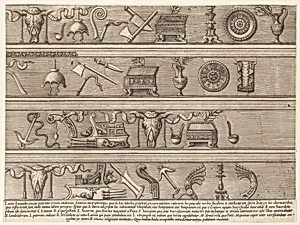
Medium
Engraving.
Dimensions
sheet: 11 7/8 x 15 13/16 in. (30.1 x 40.2 cm)
Classification
Prints
Department
Drawings and Prints
Museum
Metropolitan Museum of Art, New York, NY
Credit
Harris Brisbane Dick Fund, 1941
Accession Number
41.72(3.14)
Rights
Public Domain
Tags
Art Historical Context
Step into the Renaissance fascination with ancient Rome through *Speculum Romanae Magniae: Sacrificial Instruments on Ancient Relief Sculpture*, exquisite engraving from around 1550–75. Created by skilled engravers Nicolas Beatrizet Enea Vico, this print belongs to a renowned 16th-century series published in Rome, which meticulously reproduced classical monuments, sculptures, and. Measuring nearly 12 by 16 inches, it captures the sharp details of ritual knives and axes drawn from ancient Roman reliefs, evoking the solemnity of sacrificial ceremonies in pagan antiquity. Engraving, a precise intaglio technique where lines are incised into a metal plate and inked for transfer to paper, allowed for intricate replication of stone carvings. Beatrizet and Vico's masterful lines convey texture and form with remarkable fidelity, making classical knowledge accessible to scholars, artists, and collectors across Europe. This plate exemplifies the era's humanist revival, bridging antiquity and the Renaissance by preserving and popularizing Rome's grandeur. Today, housed in the Metropolitan Museum of Art's Drawings and Prints department (thanks to the Harris Brisbane Dick Fund of 1941), it reminds us how prints democratized art history, fueling the imagination of figures like Michelangelo and inspiring neoclassical movements centuries later. A window into ritual life—and artistic ingenuity!
About the Artist
Nicolas Beatrizet|Enea Vico · 1515–1566
Nicolas Beatrizet, born around 1515 in Lunéville, Lorraine (then part of the Holy Roman Empire), emerged as one of the most prolific French engravers of the 16th century. Little is known about his early life and training, with no records of specific teachers or apprenticeships, though regional influences from German and Italian printmaking likely shaped his skills before he arrived in Rome around ...