
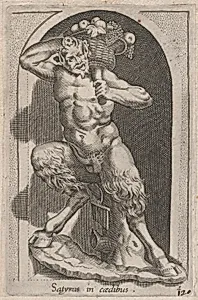
Speculum Romanae Magnificentiae: Satyr (Satyrus in caedibus)
16th century
Medium
Engraving
Dimensions
sheet: 16 5/8 x 13 1/8 in. (42.3 x 33.3 cm) plate: 4 15/16 x 3 1/8 in. (12.5 x 8 cm)
Classification
Prints
Department
Drawings and Prints
Museum
Metropolitan Museum of Art, New York, NY
Credit
Harris Brisbane Dick Fund, 1941
Accession Number
41.72(2.157)
Rights
Public Domain
Tags
About this artwork
"Speculum Romanae Magnificentiae: Satyr (Satyrus in caedibus)" by Anonymous|Antonio Lafreri|Philippe Thomassin, created in 16th century, is executed in engraving. This prints belongs to the Metropolitan Museum's Drawings and Prints collection. The work measures sheet: 16 5/8 x 13 1/8 in. (42.3 x 33.3 cm) plate: 4 15/16 x 3 1/8 in. (12.5 x 8 cm). The artwork entered the museum's collection through harris brisbane dick fund, 1941.
Art Historical Context
Step into the enchanting world of Renaissance Rome with *Speculum Romanae Magniae: Satyr (Satyrus in caedibus, a 16th-century engraving from the Metropolitan Museum of Art's Drawings and Prints collection. This print captures a mischievous satyr—a mythical half-man, half-goat from classical antiquity—amidst elements like fruit, evoking the playful, Dionysian spirit of ancient Greek and Roman lore. Published by Antonio Lafreri a pioneering Roman printmaker, and possibly involving Philippe Thomassin, it belongs to his famed *Speculum* series ("Mirror of Roman Magnificence"), a groundbreaking anthology of over 500 engravings celebrating Rome's ruins, sculptures, and artifacts. Engravings like this one were revolutionary in the 16th century, allowing the dissemination of classical imagery across Europe during the Renaissance revival of antiquity. The intimate plate size (4 15/16 x 3 1/8 in.) contrasts with the larger sheet (16 5/8 x 13 1/8 in.), suggesting it was collected in albums for study by artists, scholars, and collectors. Acquired via the Harris Brisbane Dick Fund in 1941, this anonymous work highlights the era's obsession with rediscovering pagan myths, blending historical preservation with artistic innovation. Today, it invites us to ponder satyrs' enduring symbolism of revelry and nature, bridging ancient myths to modern curiosity in a format that made grand Rome portable.
About the Artist
Anonymous|Antonio Lafreri|Philippe Thomassin
In the vast tapestry of art history, "Anonymous" stands not as a singular individual but as a collective designation for countless unidentified creators whose works have endured across millennia. These artists, spanning prehistoric cave painters to medieval illuminators and folk craftsmen, produced the foundational layers of human visual culture. Prior to the Renaissance, when individual fame emer...