
Sphere Representing Earth, Sea, and Sky [reverse]
c. 1449/1450
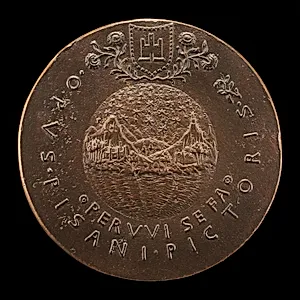
Medium
bronze
Dimensions
overall (diameter): 7.81 cm (3 1/16 in.) gross weight: 168.68 gr (0.372 lb.) axis: 12:00
Classification
Sculpture
Department
CSD
Museum
National Gallery of Art, Washington, D.C.
Credit
Samuel H. Kress Collection
Accession Number
1957.14.614.b
Rights
Public Domain
Art Historical Context
Crafted around 1449–1450 by the Italian artist Pisanello (c. 1395–1455), *Sphere Representing Earth,, and Sky [reverse]* is a masterful bronze medallion measuring just 7.81 cm in diameter and weighing 168.68 grams. Part of the Samuel H.ress Collection at the National Gallery of Art this intimate sculpture exemplifies Pisanello's pioneering role the Renaissance revival of the portrait medal—a small-scale art form inspired by Roman coins but infused with innovative detail and humanism. The reverse side depicts a symbolic sphere embodying Earth, Sea, and Sky, likely alluding to classical cosmology and the harmonious order of the universe, a theme resonant in early Renaissance thought. Pisanello's virtuoso technique shines in the fine bronze casting, achieving intricate reliefs that capture texture and depth on such a diminutive scale. His naturalistic style, honed through meticulous observation of nature, bridges Gothic traditions and the emerging Renaissance emphasis on perspective and anatomy. This medal not only showcases Pisanello's status as the foremost medalist of his era—working for courts in Ferrara and Mantua—but also highlights the medal's cultural role as a portable emblem of patronage, philosophy, and artistry. Hold it close, and you'll sense the Renaissance wonder of holding the world in your palm!
About the Artist
Pisanello · 1395–1455
Antonio di Puccio Pisano, known as Pisanello (c. 1395–1455), was a pioneering Italian painter, draftsman, and medalist born in Pisa, though he spent his early years near Verona. His early training occurred in Verona under local painters, possibly Stefano da Verona or Altichiero, fostering a style rooted in Veronese traditions. Between 1415 and 1420, he served as assistant to Gentile da Fabriano, a...