
Spherical Pendant or Button
Unknown Artist
900–950
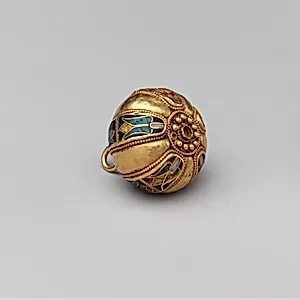
Medium
Cloisonné enamel and gold
Dimensions
Overall: 1 1/4 x 1 1/8 in. (3.2 x 2.9 cm)
Classification
Enamels-Cloisonné
Culture
Byzantine
Department
Medieval Art
Museum
Metropolitan Museum of Art, New York, NY
Credit
Purchase, The Kurt Berliner Foundation Gift, 2003
Accession Number
2003.155
Rights
Public Domain
Tags
Art Historical Context
This exquisite *Spherical Pendant or Button crafted around 900–950 during the Byzantine Empire's golden age, exemplifies the era's masterful metalwork and enameling. Measuring just ¼ x 1⅛ inches, this diminutive gold sphere—likely worn as a pendant or fastening on elite garments—showcases the technical virtuosity of Byzantine artisans. Housed in the Metropolitan Museum of Art's Medieval Department, it was acquired through the Kurt Berliner Foundation Gift in 2003. The object's medium, cloisonné enamel and gold, highlights a sophisticated technique where thin gold wires (cloisons) form compartments on the surface, filled with finely ground glass enamels in vibrant colors, then fired to fuse them into a glassy sheen. Byzantine cloisonné was prized for its durability, luminosity, and ability to mimic gemstones, often adorning imperial regalia, religious icons, and jewelry traded across Europe and the Islamic world. This piece reflects the empire's role as a cultural crossroads, blending Eastern opulence with Christian symbolism. Though its exact decoration is subtle on such a small scale, the pendant embodies Byzantine luxury—portable art for the powerful. Visitors, picture it dangling from a noble's robe, catching the light in a Constantinople basilica!