
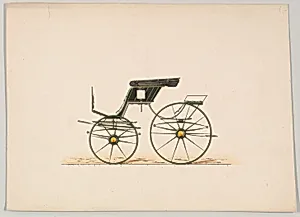
Spider Phaeton (unnumbered)
ca. 1870
Medium
Colored lithograph
Dimensions
sheet: 6 1/8 x 8 1/2 in. (15.6 x 21.6 cm)
Classification
Prints
Department
Drawings and Prints
Museum
Metropolitan Museum of Art, New York, NY
Credit
Gift of William Brewster, 1923
Accession Number
23.112.3093
Rights
Public Domain
Tags
Art Historical Context
Step into the elegant world of 19th-century equestrian luxury with *Spider Phaeton (unnumbered)*, a colored lithograph produced by renowned New York carriage makers Brewster & Co. around 1870. This charming print, measuring just 6 1/8 x 8 1/2 inches, captures the sleek lines of a "spider phaeton"—a lightweight, open four-wheeled carriage prized for its high, spindly wheels resembling spider legs, perfect for nimble city driving and stylish outings. Brewster & Co., founded in 1810, crafted these vehicles for America's elite, blending British-inspired design with American innovation during the Gilded Age. Lithography, the medium here, was a revolutionary 19th-century printing technique that allowed for vivid colors and fine details, making it ideal for promotional illustrations like this one. Likely from a catalog or advertisement, the print showcases the company's masterful craftsmanship, from polished woodwork to gleaming hardware, highlighting carriages as symbols of wealth and social status before automobiles reshaped transportation. Today, this gem resides in the Metropolitan Museum of Art's Drawings and Prints department, a gift from William Brewster in 1923. It offers a window into a vanishing era, reminding us how such vehicles defined urban sophistication and spurred artistic depictions of everyday opulence.
About the Artist
Brewster & Co. · 1837–present
**Brewster & Co.** Brewster & Company, a premier American coachbuilder renowned for its exquisite carriage designs, was established in 1810 in New Haven, Connecticut, by James Brewster (1788–1866). Born in 1788, Brewster trained as a wagonmaker's apprentice starting at age 16 in Northampton, Massachusetts, before relocating to New Haven, where he set up his workshop and quickly gained acclaim for...