
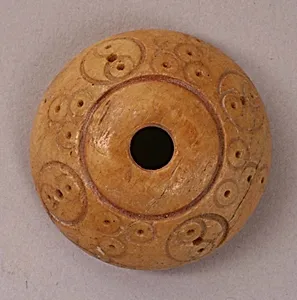
Spindle Whorl or Button
Unknown Artist
3rd–12th century
Medium
Bone; incised and inlaid with paint
Dimensions
H. 9/16 in. (1.4 cm) Diam. 7/8 in. (2.3 cm)
Classification
Ivories and Bone
Department
Islamic Art
Museum
Metropolitan Museum of Art, New York, NY
Credit
Rogers Fund, 1923
Accession Number
23.2.24
Rights
Public Domain
Art Historical Context
This delicate spindle whorl or button, crafted from bone between the 3rd and 12th centuries, a glimpse into the everyday artistry of the early Islamic world. Measuring just 9/16 inch high and 7/8 inch in diameter, it likely served a practical purpose—weighting a spindle for spinning thread or fastening clothing—yet showcases the refined craftsmanship typical of Islamic artisans. Acquired by The Metropolitan Museum of Art through Rogers Fund in 1923, it resides in the Department of Islamic Art, highlighting how functional objects were elevated through decoration. The medium of bone, incised with fine lines and inlaid with paint, reveals sophisticated techniques. Incising involved carving intricate patterns into the hard surface, then filling them with colored pigments for vibrant contrast, a method that preserved designs on durable yet lightweight material. Bone was prized in regions from the Near East to Central Asia for such small-scale works, where ivory was scarce or restricted. Culturally, this artifact underscores the Islamic emphasis on beauty in utility during the expansive Umayyad and Abbasid eras. Spindle whorls often bore geometric motifs symbolizing order and infinity, blending daily life with spiritual resonance. For visitors, it invites reflection on how ancient hands wove art into the fabric of existence.