
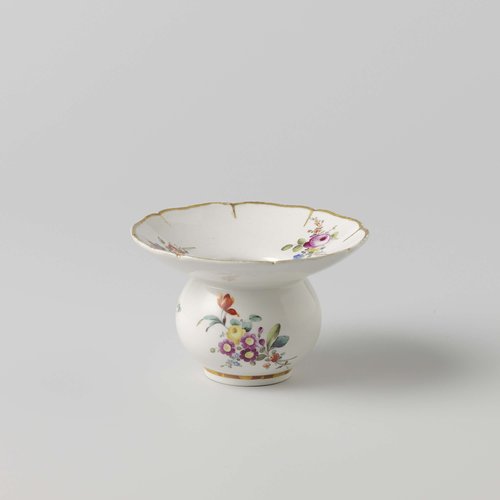
Spittoon with bouquets and flowers
c. 1777 - c. 1790
Medium
turning
Dimensions
12; 4.5; 7.5; 7.6
Rights
Public Domain
About this artwork
Kwispedoor beschilderd met veelkleurige bloemboeketten en strooibloemen. Langs de mond- en voetrand een gouden bies. Gemerkt met een ooievaar in blauw onder het glazuur en ingegrift I. N.B. Ansbachs hard porselein beschilderd in Den Haag.
Art Historical Context
This delightful spittoon, produced by the renowned Ansbach porcelain manufactory in Germany around 1777–1790, exemplifies the elegance of late 18th-century European ceramics. Crafted from hard-paste porcelain usinghe-turning techniques—a precise method that allowed for smooth, symmetrical shapes—the piece stands just 7.6 cm high and 12 cm in, making it a compact yet functional luxury item. Its surface bursts with vibrant, multicolored bouquets and scattered flowers, framed by delicate gold bands along the rim and foot, showcasing the era's love for opulent floral decoration. Ansbach, active from the mid-18th century, was celebrated for its durable, high-fired porcelain that rivaled Meissen's quality, often marked with a distinctive blue underglaze stork (as seen here) and incised details like "I.N.B." What makes this spittoon unique is its overglaze painting in The Hague, Netherlands, highlighting the international networks of the porcelain trade. Decorators there added the lively floral motifs, blending German precision with Dutch artistry. In its time, spittoons like this served a practical purpose in parlors for tobacco users, elevating everyday hygiene into refined domestic art. Today, it offers a glimpse into Rococo-era tastes, where nature-inspired designs brought joy to bourgeois homes, underscoring porcelain's role as an accessible symbol of sophistication.